On this page
- The SMR story
- Project vs. Platform
- Updates, not upgrades
- The real cost of custom
- The bottom line

Part 4 of 6 · What Fully Automated Testing Actually Enables
Why your test system needs to outlast your current product generation — and how a standardized platform delivers where custom builds erode.
“Will this system still work for us when our next product generation launches?”
It’s a fair question — and one that separates test equipment from test infrastructure. Equipment is a purchase. Infrastructure is a decision about how your validation process will work for the next decade.
SMR Automotive builds mirror systems with integrated cameras — products where the ECU complexity has grown with every generation. New communication protocols, tighter OEM requirements, more channels to validate.
They’ve been running RTStand across multiple product generations. What started as a validation system for one product line has stayed relevant through new ECU designs, new protocols, and evolving requirements — without any of the “we need to rebuild the test bench” moments that kill long-running custom setups.
“We have been using the RTStand LV124 / LV148 system from WKS Informatik for several years and are very satisfied with its high reliability and the fast, straightforward support. Regular maintenance and calibrations ensure that the system is always ready for use.”
SMR Automotive · 24 power lines · 14 bus lines
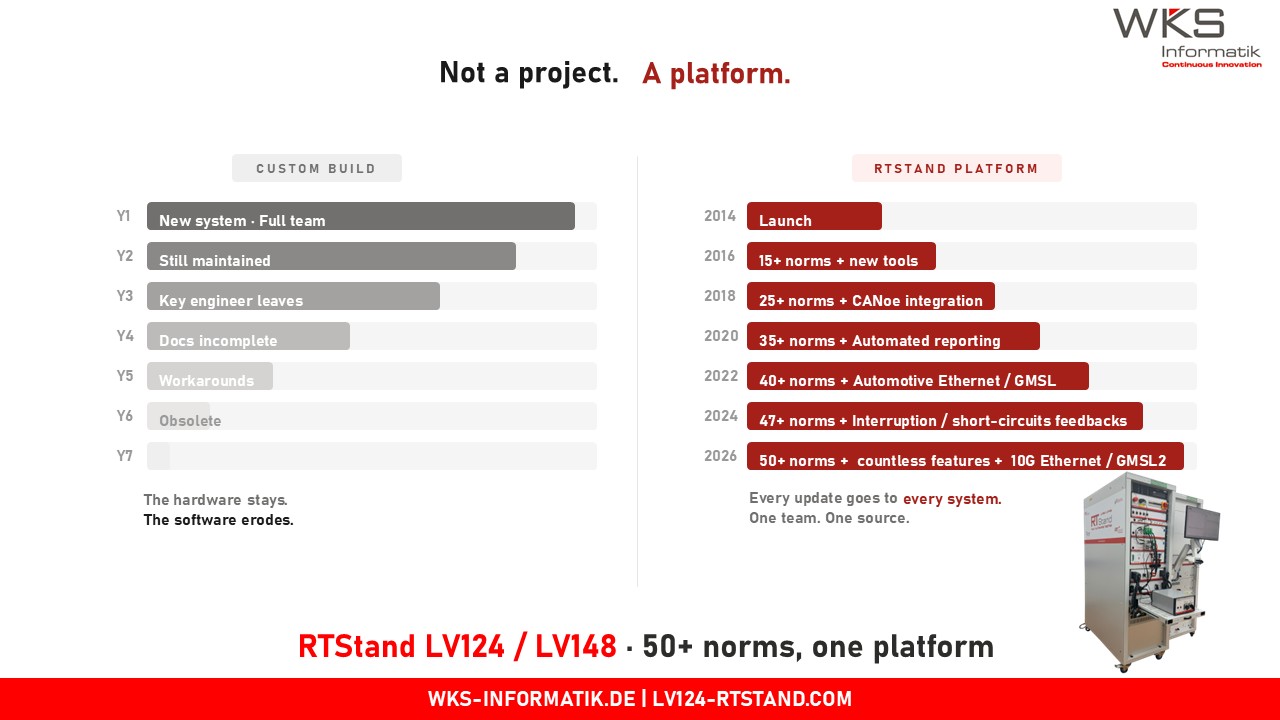
A custom-built test bench is a project. It solves today’s problem well — but it’s frozen at the moment it was delivered. The hardware stays, but the software erodes: the engineer who built it moves on, the documentation was never complete, and three years later you’re debating whether to patch it or start over.
A platform is different. It’s maintained. It evolves. It was built to be extended, not just to work once.
Every software update we release goes to every RTStand system we’ve ever shipped. This isn’t an upgrade path that requires new hardware or a new license. It’s an update — the same way your operating system updates.
Custom-built test benches don’t just age technically. They age organizationally. The engineer who designed the LabVIEW architecture retires. The contractor who wrote the CAN integration moves to another client. The person who understood the calibration procedure gets promoted.
Three years in, you’re maintaining a system that nobody fully understands anymore. Five years in, you’re building a new one.
RTStand has been in continuous development since 2014. Not because version 1 wasn’t good enough — because automotive testing doesn’t stand still. New norms, new bus systems, new OEM requirements. The system grows with them.
Speed, Depth, Reproducibility — those are the pillars of what automated testing enables. But they only matter if your system is still delivering them in five years.
Reliability is the foundation they stand on.
Your test system should not only perform today. It should still be state of the art when your next product generation is ready for validation.
That’s not support. That’s a platform commitment.
We’ll show you how RTStand handles your specific norms and ECU requirements.
RTStand LV124 / LV148
Built by WKS Informatik GmbH · Ravensburg, Germany – Imprint
We use cookies to improve your experience on our site. By using our site, you consent to cookies.
Manage your cookie preferences below:
Essential cookies enable basic functions and are necessary for the proper function of the website.
These cookies are needed for adding comments on this website.
Statistics cookies collect information anonymously. This information helps us understand how visitors use our website.
Google Analytics is a powerful tool that tracks and analyzes website traffic for informed marketing decisions.
Service URL: policies.google.com (opens in a new window)
Google reCAPTCHA helps protect websites from spam and abuse by verifying user interactions through challenges.