
In this article
Norm fundamentals — Pillar article
What is LV124 / LV148?
The complete guide for automotive engineers.
LV124 and LV148 are the two most important German automotive testing standards for electrical and electronic components. They define how ECUs must be validated under real-world electrical and environmental stress conditions — from voltage dips and short circuits to temperature cycling and electromagnetic interference.
These norms were developed by a consortium of German OEMs — including Audi, BMW, Daimler, Porsche, and Volkswagen — and are used worldwide across the automotive supply chain, from Tier 1 suppliers to test laboratories. If you build, test, or validate electronic components for vehicles, LV124 and LV148 define the tests you must pass.
Why this matters
An ECU that fails LV124 / LV148 validation cannot go into production. These are not optional guidelines — they are mandatory requirements from every major OEM. Failing late in the development cycle costs months and significant budget.
What is LV124?
LV124 governs the testing of electrical and electronic components in motor vehicles with 12V and 24V electrical systems — which covers the vast majority of vehicles on the road today.
The standard defines a comprehensive set of tests designed to verify that an ECU can withstand the electrical conditions it will encounter during the lifetime of a vehicle. These are not theoretical scenarios — they simulate real disturbances that occur in everyday driving: cold starts, load dumps when other components switch on and off, voltage drops during cranking, electromagnetic interference, and environmental extremes like heat, cold, humidity, and vibration.
LV124 covers four major test categories:
| Category | What it tests |
|---|---|
| Electrical tests | Voltage dips, surges, short circuits, load dumps, transient overvoltages, superimposed alternating voltages, slow and fast voltage changes |
| Environmental tests | Temperature cycling, humidity, thermal shock, corrosion resistance |
| Mechanical tests | Vibration, mechanical shock |
| Endurance tests | Long-term exposure to combined electrical and environmental stress over extended periods |
The electrical tests are by far the most complex part of LV124 — and the most difficult to automate. They require precise waveform generation, exact timing, and parallel monitoring of all inputs and outputs during the test.
What is LV148?
LV148 is the equivalent standard for 48V electrical systems — a newer architecture used in mild hybrid vehicles and increasingly in conventional vehicles for high-power consumers like electric power steering, active suspension, and electric turbochargers.
The 48V architecture introduces different electrical characteristics: higher voltages, different transient profiles, and new failure modes that do not exist in 12V systems. LV148 defines the test conditions and acceptance criteria specific to these systems.
Important
Many modern vehicles use both 12V and 48V networks simultaneously. ECUs that bridge both networks — like DC/DC converters — must be validated against both LV124 and LV148.
How do LV124 and LV148 differ?
Both standards follow the same structural logic — they define electrical disturbance profiles, environmental conditions, and acceptance criteria. The key differences are the voltage levels, the specific transient profiles, and some test parameters that reflect the different physical characteristics of 48V systems.
| Parameter | LV124 | LV148 |
|---|---|---|
| Network voltage | 12V and 24V | 48V |
| Target vehicles | Conventional, hybrid, electric | Mild hybrid, 48V subsystems |
| Voltage ranges | Defined around 12V / 24V nominal | Defined around 48V nominal |
| Transient profiles | 12V / 24V specific waveforms | 48V specific waveforms |
| Current requirements | Typically up to 30A, some ECUs higher | Often higher current, up to 90A+ |
| OEM adoption | Universal — all major OEMs | Growing — driven by mild hybrid adoption |
The nine main test types
LV124 and LV148 define nine categories of electrical tests. Each category targets a specific type of disturbance that an ECU may encounter in a vehicle. Understanding what each test does — and why it matters — is essential for designing a test setup that actually covers the full norm.
Power supply
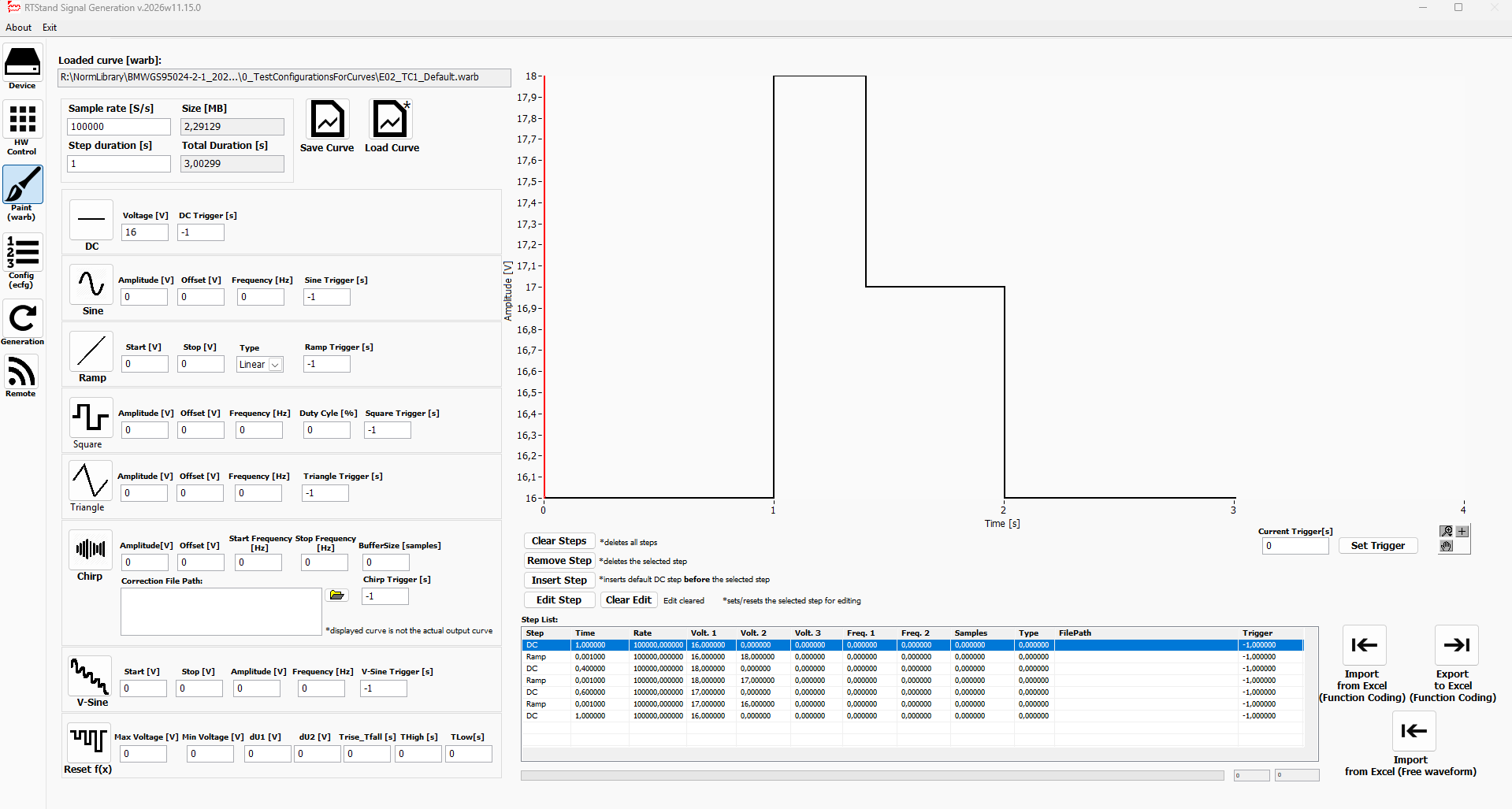
Transient voltages
Simulates sudden voltage changes on the power supply — load dumps, voltage spikes, and drops that occur when other components in the vehicle switch on or off.
Power supply
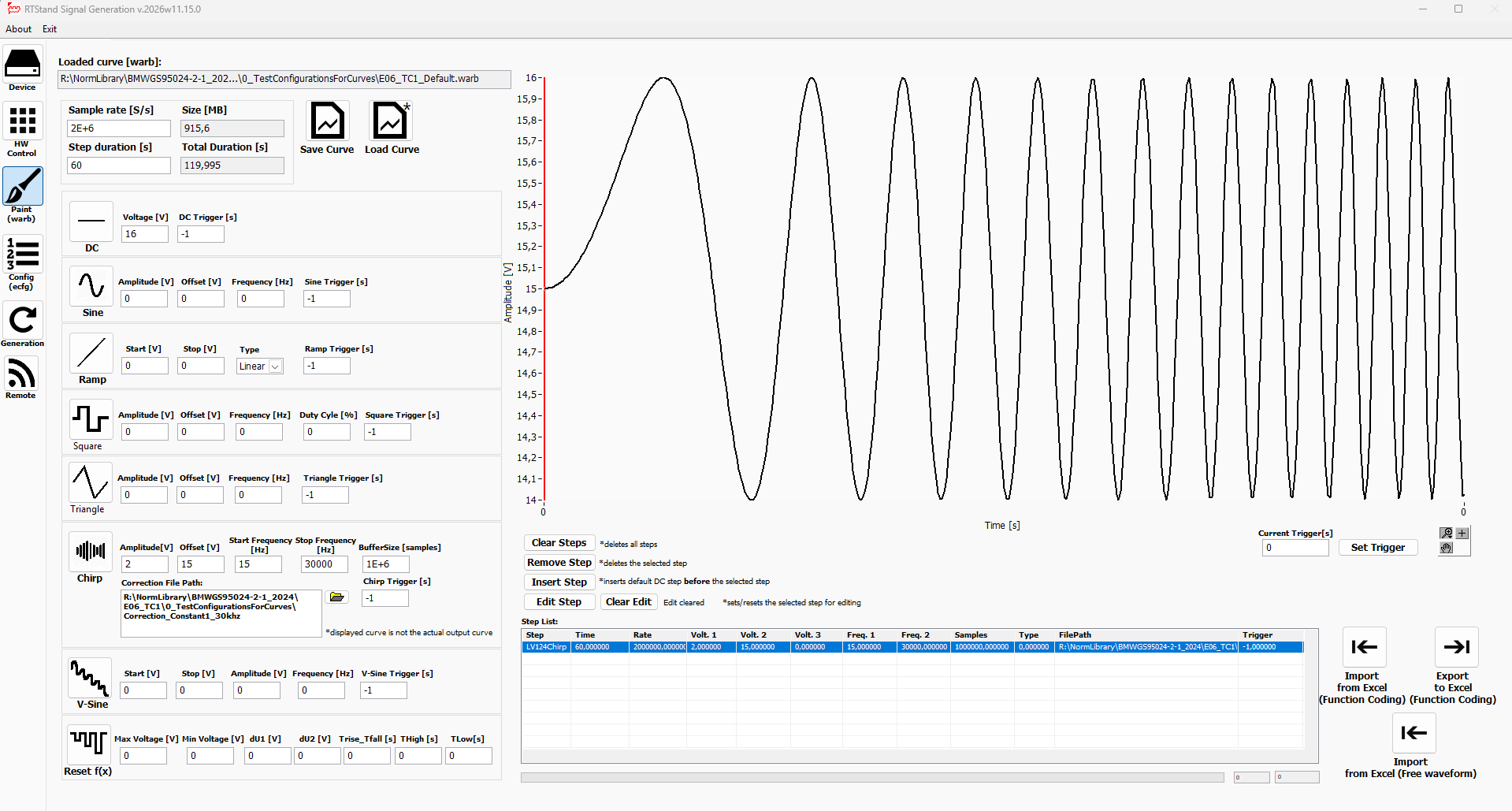
Superimposed voltages
Tests the ECU’s response to alternating voltages superimposed on the DC supply — simulating alternator ripple and other periodic disturbances.
Power supply
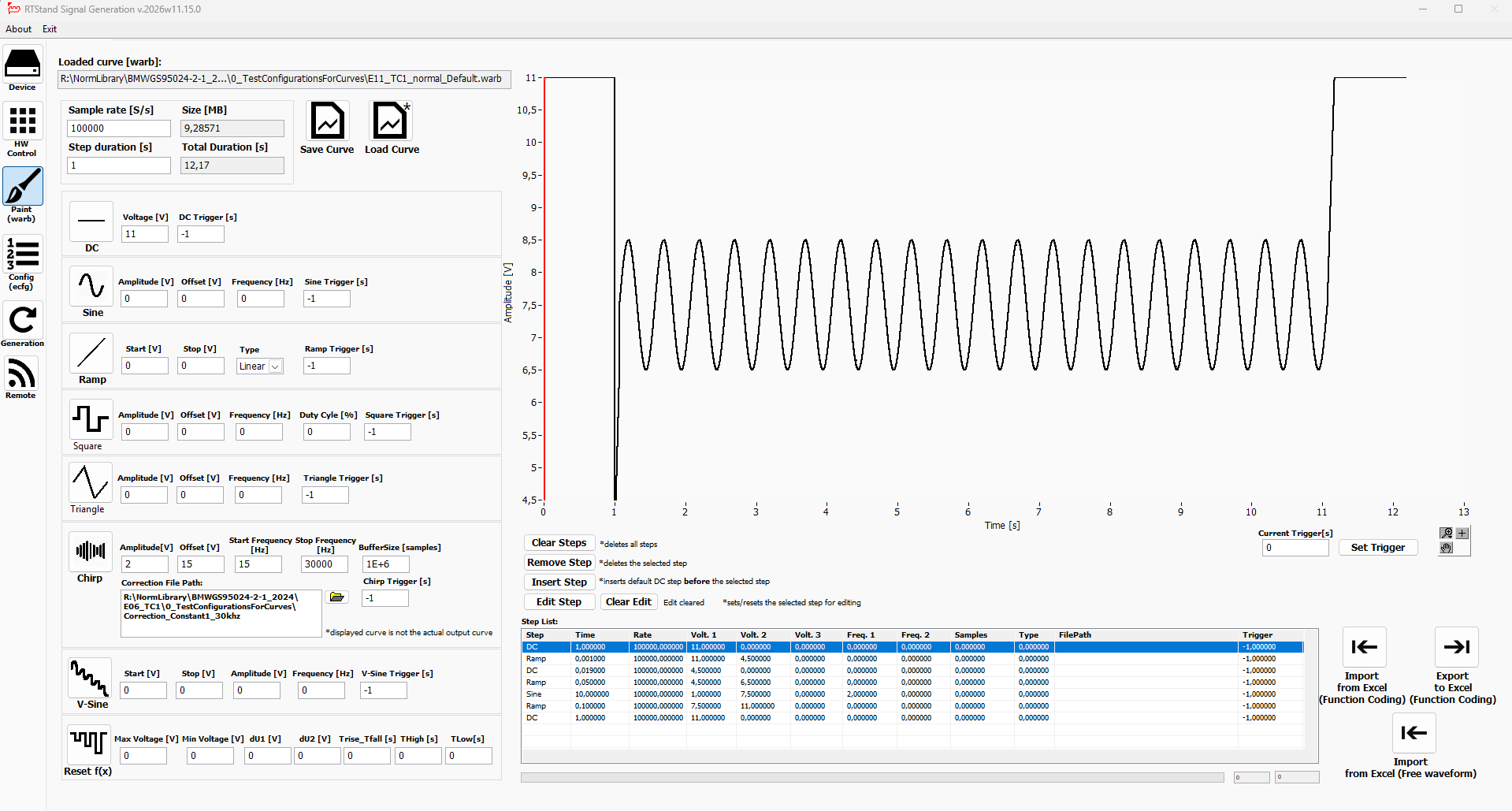
Startup voltages
Simulates the voltage profile during engine cranking – when the battery voltage drops significantly and recovers.
Pinwise — all connections
Pin interruptions
Short interruptions on individual power and signal pins — testing what happens when a connection is briefly lost due to connector issues, vibration, or corrosion.
Pinwise — all connections
Pin short-circuits
Short-circuits individual pins to supply or ground — testing the ECU’s protection mechanisms and whether it can survive or recover from short-circuit conditions.
Pinwise — all connections
Pin backfeeds / overcurrents
Tests what happens when current flows back into the ECU from external sources — a common condition in complex wiring harnesses where multiple ECUs share power lines.
Specific
Current measurements
Measures the ECU’s current consumption under different operating conditions — essential for verifying power budget compliance and detecting abnormal current draw.
Specific
On/off tests
Tests the ECU’s behaviour during power-on and power-off sequences — including sleep current, wake-up timing, and the transition between operating modes.
Additional
Additional tests
Covers edge cases and OEM-specific requirements that do not fit neatly into the other categories — including combined tests, randomised cranking profiles, and custom disturbance patterns.
Critical insight
Typical manual and half-automated test setups cover only the power supply tests (the first column above) — roughly one third of the full norm. The pinwise tests for every connection on the ECU are where coverage gaps occur, because they require parallel monitoring and automated switching across all pins. This is exactly what RTStand was designed to solve.
OEM-specific norm variants
LV124 and LV148 are the base standards — but almost every major OEM has adapted them into their own internal specification with modifications, additional requirements, or different parameter values. When an OEM sends you a test specification, it typically references one of these variants rather than the base LV124/LV148 directly.
RTStand includes a norm library covering all of the following variants — and new ones are added continuously through software updates:
LV124 * LV148 * VW 80000 (2013–2022) * VW 82148 * BMW GS95024-2-1 (2010–2026) * BMW NCAR 2023 * BMW BTTests 2023 * Audi LAH 4N0419091 (2021) * Audi LAH 895941 (2023) * Audi LAH 89A947B (2024) * MBN 10567 (2018, 2024) * MBN LV124 (2013) * ISO 16750-12V (2012, 2023) * ISO 16750-24V (2012, 2023) * ISO 21780 (2020) * GMW 3172 (2018) * MAN 12V 3499 (2017–2020) * MAN 24V 3499 (2017–2020) * Scania TB5134 (2023) * Hyundai HKMC ES95400 * FCACS00054 (2018) * PSA B217110 (2019) * QJGAC 152028 (2022) * ChangAn VS0034L10002 * Renault RNDSC00517 * Lucid EEDRCS (2023) * Zoox ESPS (2024) * McLaren MSL03040004 * Volvo LAH33721792 * JLR EMCCS (2013) * KTM T201T202 (2023) * QLiA 3800001 + continuously updated
This is the most comprehensive norm library available in any LV124 / LV148 testing system. If your OEM requires a variant not yet supported, WKS Informatik can integrate it.
Please contact WKS Informatik for the newest list of supported norms.
LV124 vs ISO 16750 — what is the difference?
ISO 16750 is the international standard for electrical testing of automotive components. LV124 was developed by German OEMs as a more specific and often more demanding alternative. In practice, the two standards overlap significantly, but there are important differences:
| Aspect | LV124 | ISO 16750 |
|---|---|---|
| Origin | German OEM consortium (VW, BMW, Daimler, Audi, Porsche) | International standard (ISO) |
| Scope | More detailed and specific test procedures | Broader, more generalised |
| Test parameters | Tighter tolerances, more test variants | Wider tolerance bands |
| OEM adoption | Mandatory for German OEMs and most European Tier 1s | Used internationally, often as a baseline |
| Pinwise tests | Extensive — interruptions, short circuits, backfeeds per pin | Less detailed pinwise requirements |
| Practical difficulty | Higher — requires more sophisticated test equipment | Achievable with simpler setups |
In practice, if you can pass LV124, you typically also pass ISO 16750. The reverse is not always true. Many suppliers choose to validate against LV124 even when the OEM only requires ISO 16750, because it provides higher confidence in component reliability.
Why LV124 / LV148 testing is hard in practice
Understanding what the norms require is relatively straightforward. Actually executing the tests — across every pin, every disturbance class, every environmental condition, with full monitoring and reproducible results — is where most test teams struggle.
The number of test cases scales with pin count
A simple ECU with 8 pins requires pinwise tests for each connection — interruptions, short circuits, backfeeds. An ECU with 96 pins requires the same tests for each of those 96 pins. The number of individual test executions grows linearly with pin count, and each one must be monitored, logged, and reported.
Communication lines must be monitored during tests
Modern ECUs communicate over CAN, LIN, Automotive Ethernet 1000base-T1, and GMSL. The norm requires monitoring these communication lines during electrical stress tests — which means your test setup must handle high-speed serial interfaces alongside power line testing, time-synchronised.
Reproducibility is essential — and hard to achieve manually
When an OEM asks you to rerun a specific test from three months ago and expects identical results, your test setup must reproduce the exact same conditions. Manual setups introduce operator variation — different wiring, different timing, different environmental conditions. Over time, results drift.
Norms evolve faster than manual setups can adapt
OEMs release updated norm variants regularly. Each update may change test parameters, add new test cases, or modify acceptance criteria. A manual setup requires manual adaptation for each change — a process that can take weeks.
Climatic integration adds another layer
Many LV124 / LV148 tests must be performed under specific temperature and humidity conditions. This requires integration with climatic chambers — which in a manual setup means yet another system to coordinate by hand.
How automation solves these challenges
The challenges above are not limitations of LV124 / LV148 as standards — they are limitations of the test infrastructure most teams use. The norms were designed to be comprehensive. The question is whether your test setup can keep up.
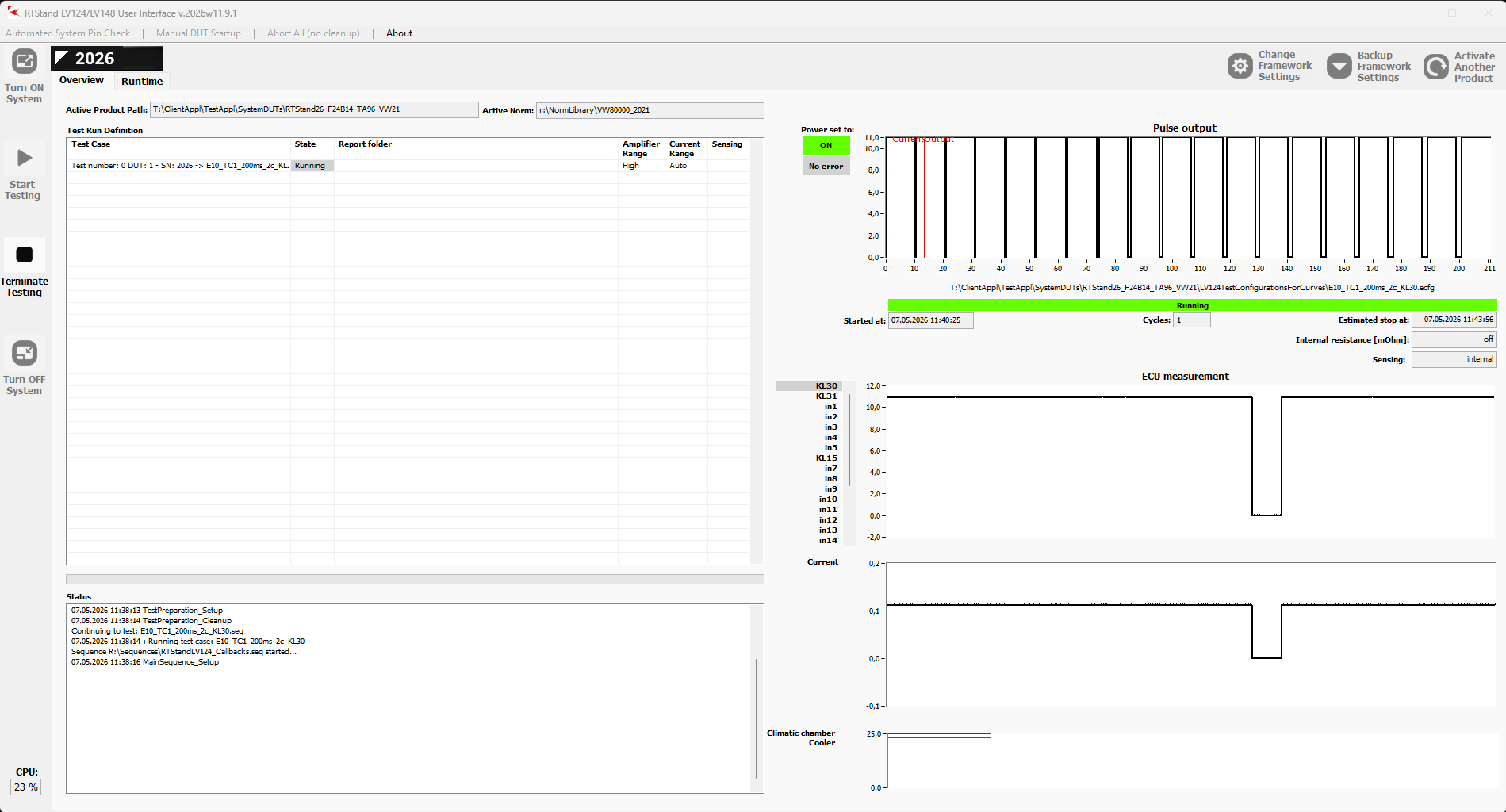
RTStand LV124 / LV148 was built specifically to address each of these challenges. It is the first and only fully automated testing platform for the complete LV124 / LV148 norm — covering all nine test types, all pinwise tests, all communication line monitoring, and all climatic integration, in a single system that runs unattended.
| Challenge | How RTStand solves it |
|---|---|
| Pin count scaling | Several system variants from 8 to 96 power pins, plus 14+ bus pins and 8+ Ethernet/GMSL pins. Generic design — reused across all ECUs. |
| Communication monitoring | Native CAN, LIN, Automotive Ethernet 1000base-T1, and GMSL support. All channels time-synchronised at 100kHz. |
| Reproducibility | 100% fully automated execution — identical conditions every run. Previously tested ECU configurations can be reloaded instantly. |
| Norm updates | 47+ norms in the built-in library. New variants integrated through software updates continuously. |
| Climatic integration | Seamless control of Weiss/Vötsch, Espec, CTS, and Lauda climatic chambers — fully automated within the test run. |
| Reporting | Fully automated report generation with time-synchronised voltage, current, and bus communication data. Customisable views for online and offline analysis. |
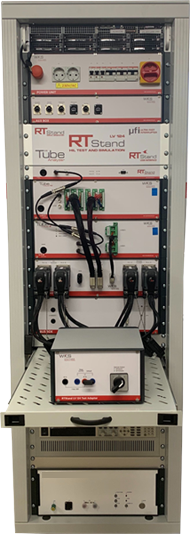
See RTStand in action with your own ECU.
Visit the WKS Informatik test lab in Ravensburg for a hands-on assessment day — or ship your DUT for a full norm run. No commitment needed.
RTStand LV124 / LV148
Built by WKS Informatik GmbH · Ravensburg, Germany – Imprint