On this page
- What auditors look for
- The documentation tax
- DAkks-calibrated measurements
- Norm traceability
- Version control
- Consistency across sites
- What this means for your team
- The series in perspective

Part 6 of 6 · What Fully Automated Testing Actually Enables
Why the hardest part of an audit shouldn’t be the documentation — and how a platform approach makes audit readiness the default, not the exception.
“The auditor is coming next week.” Five words that shouldn’t cause panic.
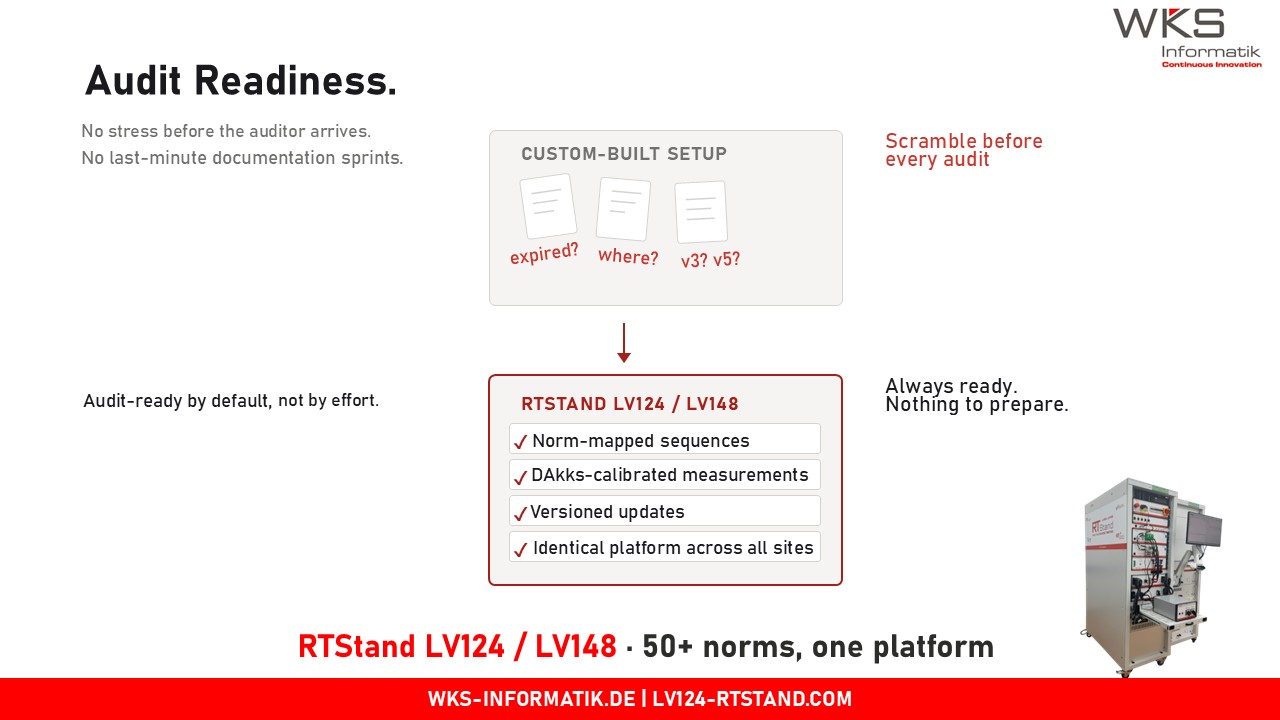
In most test labs, those words trigger a scramble. Engineers pull test reports from scattered folders. Calibration certificates get tracked down. Someone checks whether the last norm update was actually implemented or just discussed. Documentation that should have been maintained all year gets assembled in a week.
It works — usually. But the effort is enormous, the stress is real, and the outcome depends entirely on how well someone remembers where everything is stored.
An audit isn’t a mystery. The requirements are known in advance, and they come down to the same fundamental questions every time:
Traceability. Can you show exactly which norm requirements were tested, with which parameters, on which date? Calibration. Are the measurement instruments calibrated, and can you prove it? Version control. When the norm changed, did your test sequences change with it — and can you show when? Consistency. Does the same test produce the same result across different systems, different sites, different operators?
None of these are unreasonable. None of them are surprising. And yet, in labs that run custom-built test setups, answering them often requires days of preparation — because the evidence exists, but it’s scattered across file servers, personal folders, email threads, and someone’s memory.
The problem isn’t missing data. It’s missing structure.
Custom-built test systems generate results. But they rarely generate the kind of structured, traceable, versioned documentation that an auditor needs to see. That documentation gets created manually — after the fact, under time pressure, by people who should be testing, not filing.
Every test lab pays a documentation tax. The question is when and how.
With a custom setup, the tax comes due at audit time. It arrives as a concentrated burst of effort: pulling together calibration records, cross-referencing norm versions with test sequences, verifying that the right parameters were applied at the right time. Engineers who should be running tests spend their time assembling evidence instead.
The stress isn’t just about the workload. It’s about the uncertainty. Did we capture everything? Is that calibration certificate still valid? Was the sequence updated when the norm changed in March, or was that the one we postponed?
This is the effort that nobody budgets for when they commission a custom test system. And it’s the effort that compounds every year as more norms, more DUT variants, and more test results accumulate without a system to organize them.
Calibration is one of the first things an auditor checks — and one of the most common sources of stress. Are the instruments calibrated? By whom? When? Is the certificate current?
Every RTStand LV124 / LV148 system is delivered with DAkks-calibrated measurements. DAkks — the Deutsche Akkreditierungsstelle — is Germany’s national accreditation body. A DAkks calibration isn’t just a sticker on an instrument. It’s a documented, traceable confirmation that the measurement chain meets national and international standards.
This means that when an auditor asks about calibration, the answer isn’t a search through filing cabinets. It’s part of the system’s delivery documentation. The calibration status is known. The certificates are available. The traceability is established from the first measurement.
Calibration isn’t a maintenance task. It’s a delivery standard.
WKS delivers every RTStand system with DAkks-calibrated measurement chains. The customer doesn’t need to arrange initial calibration, verify the measurement setup, or wonder whether the instruments meet the required accuracy. It’s handled before the system arrives.
The second thing auditors want to see is norm traceability. Not just that you test against a norm — but that your test sequences map to specific norm requirements, and that when the norm changes, your implementation changes with it.
In a custom-built system, this traceability lives in the engineer’s head, in a specification document that may or may not be current, and in code comments that may or may not match what the code actually does. Proving it requires walking the auditor through the implementation, explaining which code block corresponds to which norm clause.
In RTStand, norm traceability is architectural. The norm library contains over 50 norm variants, each mapped to specific test sequences. When a norm is updated, the corresponding sequences are updated in the library. When a customer receives an update, the change history travels with it — what changed, when, and why.
One of the most uncomfortable moments in an audit is the version question: “When did you implement the latest norm revision?” With a custom setup, the honest answer is often: “Let me check.” And then someone looks through commit logs, email threads, or deployment notes to reconstruct when the change actually happened.
RTStand’s update mechanism eliminates this ambiguity. Every update is versioned. Every deployment is logged. When an auditor asks when a norm change was implemented, the answer is a date — not a search.
This isn’t just convenient. It’s the difference between an audit that runs smoothly and one that raises follow-up questions. Auditors don’t fail you for having outdated documentation. They flag it — and then they look more closely at everything else. A clean version history sets the tone for the entire audit.
For organizations running test labs at multiple sites, audits carry an additional challenge: proving that the same test, run at two different locations, produces equivalent results under equivalent conditions.
With custom setups, each site is its own island. Different hardware configurations, different software versions, different calibration schedules. An auditor who visits Site A and then Site B is effectively auditing two different systems.
RTStand is the same platform everywhere it runs. Same norm library. Same test sequences. Same measurement architecture. Same update cycle. When an auditor walks into any RTStand installation, they’re looking at a system they could have seen at any other customer site. That consistency isn’t just an engineering advantage — it’s an audit advantage.
Audit readiness isn’t a state you prepare for. It’s a state you maintain.
With a standardized platform, documentation is a byproduct of normal operation — not a separate activity. Test reports are structured. Calibration is documented. Version history is automatic. The audit doesn’t require extra effort because the evidence is generated as the system works.
The real benefit of built-in audit readiness isn’t passing the audit. Your team was going to pass it anyway — they always do, because they put in the work. The real benefit is what that work costs them.
No last-minute documentation sprints. No stress about missing calibration certificates. No uncertainty about whether the latest norm revision was actually implemented. No weekend shifts before the auditor arrives on Monday.
Your test engineers get to do what they were hired to do: test. Not file. Not search. Not reconstruct what happened six months ago from memory and folder structures. The platform handles the documentation. The people handle the engineering.
This is the final article in the series “What Automated Testing Actually Enables.” Over six parts, we’ve looked at the capabilities that a platform-based approach to automotive component testing delivers — and the structural risks it eliminates:
Depth — seeing beyond pass/fail into the behavior of the DUT. Speed — reducing test cycles from weeks to days. Reproducibility — ensuring results you can trust and defend. Reliability — building infrastructure that doesn’t degrade. Continuity — surviving the inevitable departure of key engineers. And Audit Readiness — making compliance a byproduct, not a project.
Each of these matters on its own. Together, they describe a test infrastructure that serves the organization — not the other way around.
A test system that’s always audit-ready is a test system that respects your team’s time. And that might be the most practical thing automated testing enables.
We’ll show you how RTStand handles your specific norms and ECU requirements.
RTStand LV124 / LV148
Built by WKS Informatik GmbH · Ravensburg, Germany – Imprint
We use cookies to improve your experience on our site. By using our site, you consent to cookies.
Manage your cookie preferences below:
Essential cookies enable basic functions and are necessary for the proper function of the website.
These cookies are needed for adding comments on this website.
Statistics cookies collect information anonymously. This information helps us understand how visitors use our website.
Google Analytics is a powerful tool that tracks and analyzes website traffic for informed marketing decisions.
Service URL: policies.google.com (opens in a new window)
Google reCAPTCHA helps protect websites from spam and abuse by verifying user interactions through challenges.