On this page
- The sporadic fault
- What “depth” means
- Speed + Reproducibility
- In practice
- The bottom line

Part 1 of 6 · What Fully Automated Testing Actually Enables
How simultaneous full-DUT monitoring — supply, CAN, LIN, Ethernet, all time-synchronized — reveals the faults that only surface after hundreds of test cycles.
Some faults don’t show up. Not in the first hour. Not in the first night. Not in the first hundred test cycles. Finding them requires something that manual testing structurally cannot deliver: running the same sequence, under identical conditions, for days or weeks — while monitoring everything at once.
“Automation in testing isn’t about efficiency. It’s about a depth of testing that manually, structurally, doesn’t exist.”
A premium OEM we’re working with is looking for exactly one of those invisible faults right now. A sporadic effect in serial production, on a type-approval-relevant component. Not findable by other means — because the test has to run under identical, reproducible conditions. And for a long time. A very long time.
Manually? Not an option. An engineer can’t run the same sequence, reproducibly, for 24 hours straight — let alone for weeks. And even if they could, they’d be watching one signal at a time, hoping the fault happens while they’re looking at the right channel.
That’s the structural limitation. It’s not about effort or competence. It’s about what a human can physically observe, simultaneously, over time.
Depth isn’t just running more cycles. It’s seeing more — in every cycle. RTStand monitors the entire DUT at once: supply lines, CAN, LIN, Ethernet — all time-synchronized, around the clock. Not one signal at a time, checked separately. Everything, together, for as long as it takes.
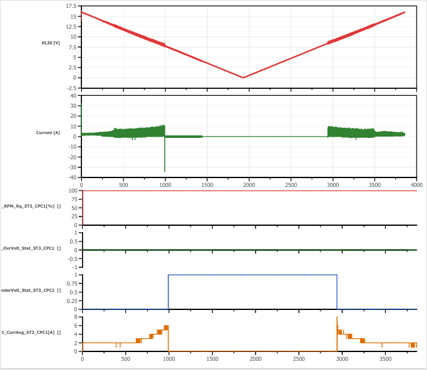
This simultaneous monitoring is what makes the difference. When a fault surfaces in run 314, you don’t just know that something happened — you know exactly what every channel was doing at that exact moment. The supply voltage dipped 200ms before the CAN error frame? That correlation only exists if you’re capturing everything at once.
Here’s the thing about depth that’s easy to miss: it doesn’t exist in isolation. Finding a sporadic fault after hundreds of cycles only works because two other things are already in place.
Speed gives you the time. If each test cycle takes hours instead of minutes, you’ll never run enough cycles to surface the rare fault. Automation compresses the cycle time so dramatically that running 500 repetitions becomes feasible — not just theoretically, but overnight, unattended.
Reproducibility gives you the trust. When something looks different in run 314, you need to know that the difference is the fault, not test variability. Every run has to be identical — same timing, same sequencing, same environmental conditions — so that a deviation means something.
Speed and reproducibility only get you the opportunity to look.
Depth is what you actually see once you do. The simultaneous full-DUT monitoring, the time-synchronized capture across all channels, the ability to correlate a supply transient with a bus fault that happened 200 milliseconds later — that’s depth.
RTStand is worth its weight in gold to this customer. Not because of the features themselves — because of what the features enable: catching a fault before it comes back later, in type approval — or in the field.
The fault this OEM is chasing? It’s the kind that shows up once in several hundred cycles. With manual testing, they would have declared the component “passed” after the first clean run. With RTStand, they found it — because the system ran long enough, reproducibly enough, and captured enough data to make the invisible visible.
Depth is the first pillar of what automated testing actually enables — and arguably the most important one. Not because speed and reproducibility don’t matter, but because depth is the outcome they make possible.
Automated testing isn’t about efficiency. It’s about a depth of testing that manually, structurally, doesn’t exist.
We’ll show you how RTStand handles your specific norms and ECU requirements.
RTStand LV124 / LV148
Built by WKS Informatik GmbH · Ravensburg, Germany – Imprint
We use cookies to improve your experience on our site. By using our site, you consent to cookies.
Manage your cookie preferences below:
Essential cookies enable basic functions and are necessary for the proper function of the website.
These cookies are needed for adding comments on this website.
Statistics cookies collect information anonymously. This information helps us understand how visitors use our website.
Google Analytics is a powerful tool that tracks and analyzes website traffic for informed marketing decisions.
Service URL: policies.google.com (opens in a new window)
Google reCAPTCHA helps protect websites from spam and abuse by verifying user interactions through challenges.