On this page
- The scenario
- What walks out the door
- The cost of rebuilding
- What a platform changes
- The onboarding test
- The bottom line

Part 5 of 6 · What Fully Automated Testing Actually Enables
Why your test system shouldn’t depend on the engineer who built it — and what happens when institutional knowledge walks out the door.
“The engineer who built this just left. And nobody else knows how it works.”
It’s the most common failure mode in test engineering — and it has nothing to do with hardware, software, or measurement accuracy. It’s a people problem. And it’s structural.
A skilled engineer builds a test setup. It works well. It runs reliably. It was the right solution at the time. Over the next few years, the same engineer adds features, fixes edge cases, writes workarounds for specific DUT variants. The system grows — but only in that engineer’s head.
Then they leave. Maybe they retire. Maybe they take a better offer. Maybe they move to a different department. The reason doesn’t matter. What matters is what walks out the door with them.
This isn’t a worst case. It’s the default trajectory of every custom-built test system that depends on one person’s expertise.
When an experienced test engineer leaves, the loss isn’t just their time. It’s a specific, layered kind of knowledge that no handover document captures:
Why the signal routing is configured the way it is — not just how. Which timing parameter was adjusted after a specific DUT showed sporadic failures. How the calibration procedure accounts for temperature drift in the lab. Where the workaround for that one connector pinout issue lives in the code.
This is institutional knowledge. It’s not in the documentation — because it was never written down. It was never written down because it was never meant to be permanent. But three years of accumulated fixes and adjustments aren’t temporary. They’re the system.
The documentation gap isn’t laziness. It’s structural.
Custom-built test systems are, by definition, one-off implementations. There’s no external reference. No shared standard. No second team that built the same thing differently. The documentation would have to explain not just what the system does, but every decision that led to why it does it that way — and that level of documentation almost never exists.
When a custom test system loses its architect, the organization faces a choice. Maintain a system nobody fully understands — or rebuild.
Both options are expensive. Maintaining means every change carries risk. Nobody wants to touch the timing parameters because nobody knows the side effects. New DUT variants get tested with workarounds on top of workarounds. The system becomes increasingly fragile.
Rebuilding means starting over. New development budget. New timeline. And the uncomfortable realization that you’re about to spend a year recreating capabilities you already had — plus the risk that the new system will follow the same trajectory in another five years.
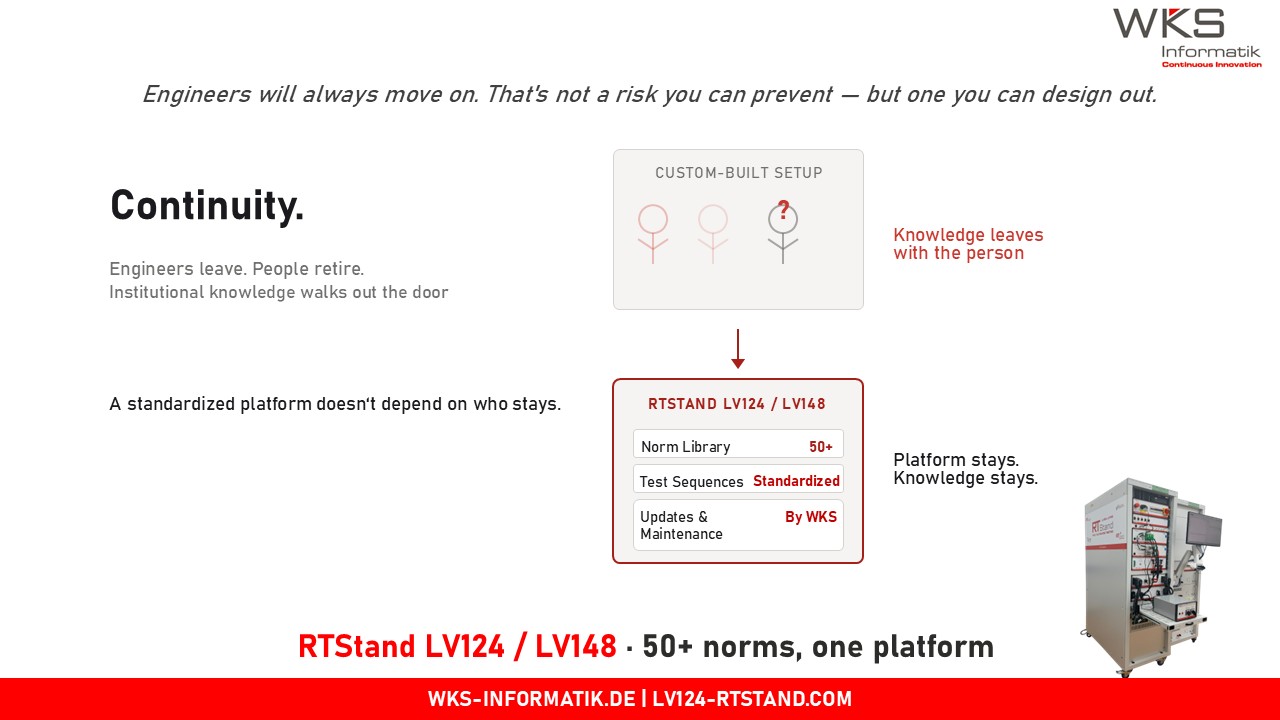
RTStand LV124 / LV148 is not a project that gets delivered and frozen. It’s a platform — maintained, updated, and documented by the same team that built it.
When a test engineer at a customer site leaves, the system doesn’t leave with them. The norm library is the same. The test sequences are the same. The hardware abstraction is the same. A new team member doesn’t need to reverse-engineer years of accumulated tribal knowledge. They need to learn one platform — the same platform that every other RTStand customer uses.
This is what continuity looks like in practice. Not a promise that nothing will change — but the guarantee that when it does, the change is managed, validated, and deployed by the people who know the system best.
Here’s a simple way to evaluate your test infrastructure’s resilience: imagine your most experienced test engineer hands in their notice tomorrow. How long until someone else can run the system confidently?
With a custom setup, that answer is usually measured in months — if it’s possible at all without the original builder. With a standardized platform, the answer is measured in days. Because the system is the same everywhere it runs, and the documentation doesn’t live in one person’s desk drawer.
Continuity isn’t about preventing turnover.
People will always move on. That’s not a risk you can prevent. But it’s a risk you can design out of your test infrastructure. A system that depends on who operates it is a liability. A system that works regardless of who operates it is an asset.
Depth, Speed, Reproducibility, Reliability — those are the capabilities that automated testing enables. But they only deliver value if your organization can sustain them through the natural cycle of people joining and leaving.
Continuity is what keeps the other four alive.
Your test infrastructure should outlast any single person’s tenure. Not because people don’t matter — but because the work they do on a standardized platform stays, even when they don’t.
We’ll show you how RTStand handles your specific norms and ECU requirements.
RTStand LV124 / LV148
Built by WKS Informatik GmbH · Ravensburg, Germany – Imprint
We use cookies to improve your experience on our site. By using our site, you consent to cookies.
Manage your cookie preferences below:
Essential cookies enable basic functions and are necessary for the proper function of the website.
These cookies are needed for adding comments on this website.
Statistics cookies collect information anonymously. This information helps us understand how visitors use our website.
Google Analytics is a powerful tool that tracks and analyzes website traffic for informed marketing decisions.
Service URL: policies.google.com (opens in a new window)
Google reCAPTCHA helps protect websites from spam and abuse by verifying user interactions through challenges.