On this page
- “It passed” problem
- Three runs, three results
- What reproducibility looks like
- The quiet foundation
- The bottom line

Part 3 of 6 · What Fully Automated Testing Actually Enables
Why “it passed” only means something if you can prove it would pass again — and how automated testing eliminates the variability that makes manual results unreliable.
A failure that only appears under a rare combination of conditions is only useful if you can create that exact combination again. On demand. Identically. As often as it takes to understand it.
One of our customers validates safety-critical ECUs. Safety belt systems, ABS, zone controllers. Dozens of variants. Zero tolerance for anything that can’t be explained.
Their problem with manual testing wasn’t speed. It wasn’t even depth. It was this: “it passed” only ever meant “it passed this time, with this setup, run by this engineer.”
Setup varies slightly. Timing drifts. Two people read the same borderline result differently. For a safety-critical component, that’s not a detail. That’s the whole question.
“Manual testing gives you effort. Automated, reproducible testing gives you certainty.“
Here’s what we see almost every time we run the same test three times in a row instead of once: run 1 passes clean. Run 2 shows a different behavior — no restart after the second pulse. Run 3 shows yet another behavior — no restart after the first pulse.
With manual testing, one of these three becomes the run that ships to production. The other two never happen. Not because they don’t matter — because nobody ran them.
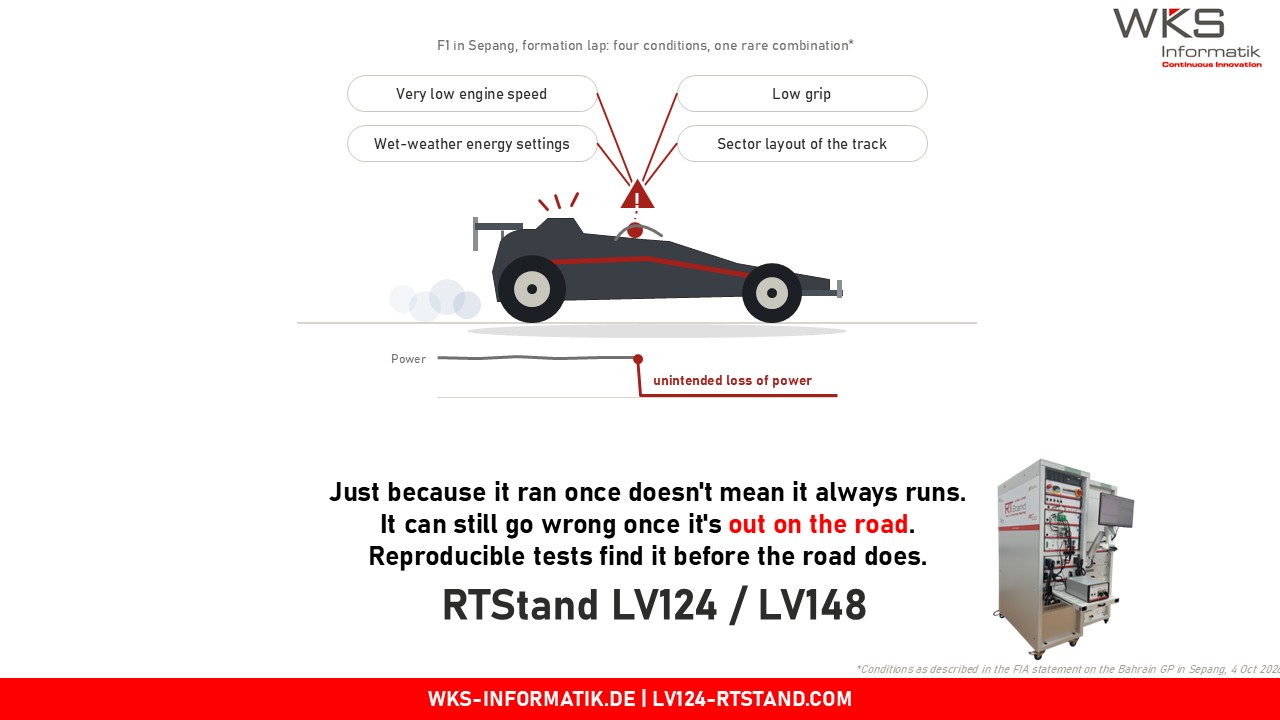
With RTStand, every run is identical. Cycle for cycle. Signal for signal. If it passed run 1, it passes run 1,000 — because run 1,000 is literally the same test as run 1. And when it fails, you can actually find out why, because nothing else changed.
That’s the critical difference. In manual testing, when something fails, you’re never sure whether the fault is in the DUT or in the test. The setup drifted. The timing was slightly different. The engineer misread a borderline value. In automated testing, when a deviation appears, you know it’s real — because the test is provably identical every time.
“With a fully automated test run, there is no room for slight variations in the test runs anymore.”
ZF Lifetec – Safety-critical ECU validation
This is the part of automated testing that doesn’t make for dramatic stories. Nobody writes a LinkedIn post about “our test results are consistently identical.” But reproducibility is the quiet foundation under everything else in this series.
Speed gives you the time for more cycles. Depth shows you what hides in them. Reproducibility is why you can trust what you see.
Without reproducibility, speed just means running unreliable tests faster. Without reproducibility, depth just means collecting more data you can’t trust. It’s the invisible pillar — the one nobody talks about until it’s missing.
The reproducibility test:
If your test result would be different with a different engineer running it, a different time of day, or a slightly different ambient temperature — you don’t have a test result. You have an anecdote.
RTStand eliminates every variable except the one that matters: the DUT itself.
Reproducibility doesn’t make for the most exciting headline. But it’s the difference between a test result and a test opinion. Between “it passed” and “it will pass again.”
Run 1 equals run 1,000. Same setup. Same timing. Same procedure. That’s not a feature. That’s the definition of a reliable test.
Manual testing gives you a result. RTStand gives you certainty.
We’ll show you how RTStand handles your specific norms and ECU requirements.
RTStand LV124 / LV148
Built by WKS Informatik GmbH · Ravensburg, Germany – Imprint
We use cookies to improve your experience on our site. By using our site, you consent to cookies.
Manage your cookie preferences below:
Essential cookies enable basic functions and are necessary for the proper function of the website.
These cookies are needed for adding comments on this website.
Statistics cookies collect information anonymously. This information helps us understand how visitors use our website.
Google Analytics is a powerful tool that tracks and analyzes website traffic for informed marketing decisions.
Service URL: policies.google.com (opens in a new window)
Google reCAPTCHA helps protect websites from spam and abuse by verifying user interactions through challenges.