On this page
- The Tier-1 story
- The unexpected request
- Speed isn’t efficiency
- What speed enables
- The bottom line

Part 2 of 6 · What Fully Automated Testing Actually Enables
Why a Tier-1 customer’s OEMs asked them to reinvest freed-up test time into more validation cycles, not lower cost — and what that means for the industry.
At the trade show in Stuttgart, a Tier-1 customer told us that they test a specific module on our system. Before automation: five weeks. Now: five days. Six times faster.
Sounds like an efficiency story, right? But the interesting part comes after.
“Time saved isn’t the actual outcome of automation. The actual outcome is what happens with the time that didn’t exist before.”
Their own customers — premium OEMs — didn’t say “cool, you’re faster now, we’ll pay you less.” They said: “Cool, now you have time for more test cycles. Please use it. As a safeguard.”
So the same module doesn’t just get tested once anymore — it gets tested multiple times. With different parameters. With repetition. With a completely different confidence level at the end.
Better quality for the end product. More billable test time for the Tier-1 — better business, not worse.
->
“Testing faster” gets discussed as a cost argument in almost every customer conversation I’ve been part of. We save engineering hours, we save setup time, we save cycle time. All true. But it undersells the strategic point.
Automation shifts the question. Instead of “can we run the required tests in the required time?” it becomes “what can we do now that we couldn’t before?”
More repetitions. More variants. Longer endurance runs. A more complete environmental signal. Additional safeguard runs that used to be impossible. That’s not the same as efficiency. That’s a jump in validation quality that only automation makes possible.
The real shift:
Before automation, the question was: “Do we have enough time to run all required tests?” After automation, the question becomes: “What else can we test now that we have the time?” That’s a fundamentally different competitive position — not cheaper testing, but deeper, more thorough validation.
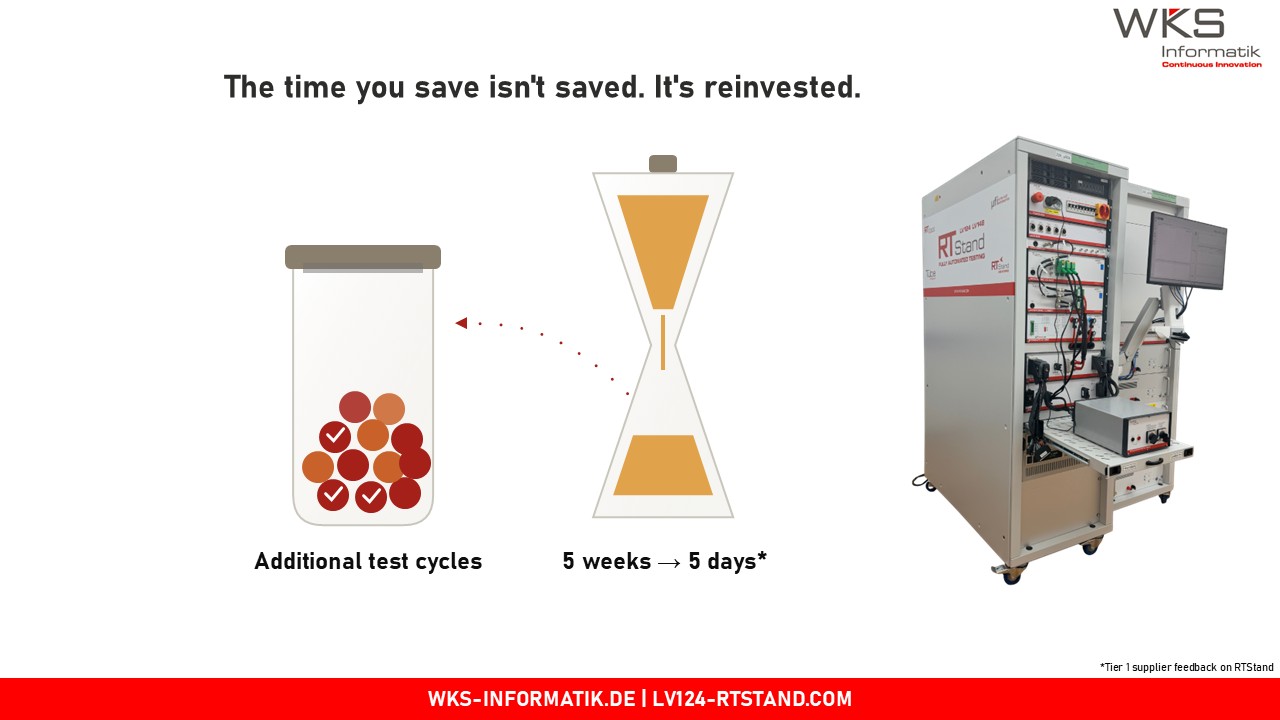
Speed is the enabler for everything else in this series. Without compressed cycle times, you can’t run enough repetitions for depth. Without overnight and weekend operation, you can’t sustain the volume that makes sporadic faults visible.
The customer who understood this early is in a structurally better competitive position today. Not because they got cheaper. Because they got deeper.
Speed in automated testing is not about doing the same thing faster. It’s about doing things that weren’t possible before — more cycles, more variants, longer endurance runs — because the time now exists.
The customer who gets faster doesn’t save money. They gain depth.
We’ll show you how RTStand handles your specific norms and ECU requirements.
RTStand LV124 / LV148
Built by WKS Informatik GmbH · Ravensburg, Germany – Imprint
We use cookies to improve your experience on our site. By using our site, you consent to cookies.
Manage your cookie preferences below:
Essential cookies enable basic functions and are necessary for the proper function of the website.
These cookies are needed for adding comments on this website.
Statistics cookies collect information anonymously. This information helps us understand how visitors use our website.
Google Analytics is a powerful tool that tracks and analyzes website traffic for informed marketing decisions.
Service URL: policies.google.com (opens in a new window)
Google reCAPTCHA helps protect websites from spam and abuse by verifying user interactions through challenges.