
In this article
Norm fundamentals
LV 124 vs LV 148 vs ISO 16750 — what is the difference?
Three norms, one goal, different scopes
Engineers working in automotive electrical testing inevitably encounter three standards: ISO 16750 (ISO16750), LV 124 (LV 124), and LV 148 (LV 148). All three define how to validate that an electronic component survives the electrical environment inside a vehicle. But they differ in origin, specificity, and how precisely they define test parameters.
The confusion is understandable. The norms overlap significantly, reference each other, and many OEMs layer their own requirements on top. This article explains each norm separately, then shows where they align and where they diverge.
The short answer
ISO 16750 is the international baseline — it defines test types with general curves and average values for all road vehicles. LV 124 is not a single norm but an umbrella term for OEM-specific testing standards (VW 80000, BMW GS95024, MBN 10567, etc.) that take ISO 16750 as a starting point and add more precise, OEM-specific test parameters. These OEM norms cover 12V, 16V, and 24V systems across passenger cars, trucks, buses, and agricultural machinery — and many non-German OEMs now adopt them or build their own. LV 148 is the 48V extension for mild hybrid systems.
ISO 16750 — the international baseline
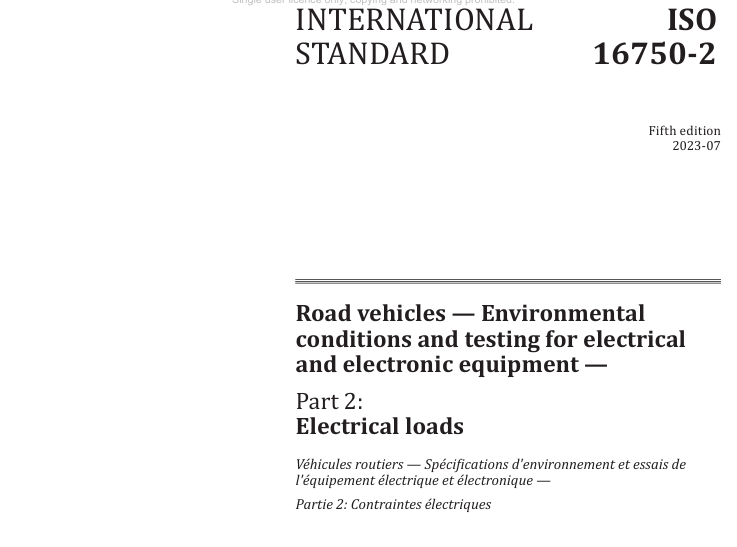
ISO 16750 (“Road vehicles — Environmental conditions and testing for electrical and electronic equipment”) is published by the International Organization for Standardization. It defines the environmental conditions that electrical and electronic equipment in road vehicles must withstand.
ISO 16750 is divided into five parts:
- Part 1: General — classification of equipment by mounting location and electrical load
- Part 2: Electrical loads — voltage supply tests, transients, overvoltage, reverse polarity, and more
- Part 3: Mechanical loads — vibration, mechanical shock, free fall
- Part 4: Climatic loads — temperature, humidity, thermal shock, salt spray, dust
- Part 5: Chemical loads — exposure to fluids, fuels, cleaning agents
For electrical testing — which is what RTStand covers — Part 2 is the relevant section. It defines voltage supply test profiles, including superimposed AC voltage, slow and fast voltage transients, load dump, jump start, reversed polarity, and ground offset.
Key characteristic
ISO 16750 is generic and vehicle-neutral. It applies to any road vehicle — passenger cars, trucks, motorcycles, buses. It defines the full range of test types (including short interruptions, transients, and communication tests) but provides severity levels rather than fixed parameters. The vehicle manufacturer selects the appropriate severity level or defines their own specific values — which is how OEM-specific norms are born.
LV 124 — not a single norm, but a family
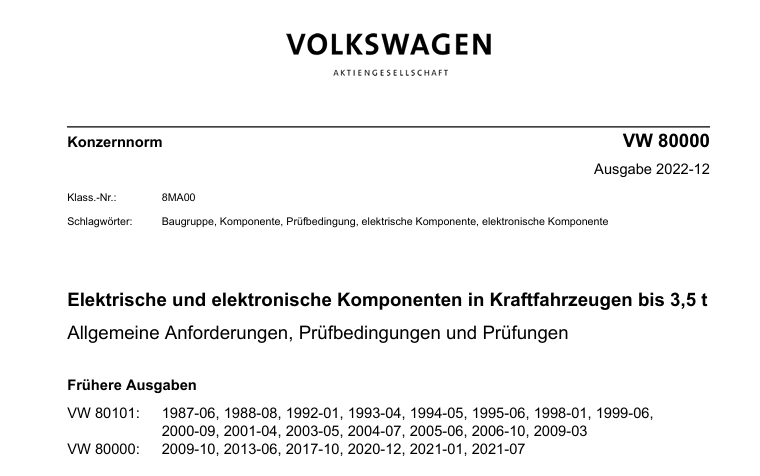
LV 124 is not a single document that you can download and test against. It is an umbrella term for a family of OEM-specific electrical testing norms that originated with the German automotive manufacturers — Volkswagen, BMW, Mercedes-Benz, Porsche, and Audi. When someone says “we test according to LV 124,” they actually mean they test according to one or more OEM norms that fall under this umbrella — VW 80000, BMW GS95024-2-1, MBN 10567, and so on.
These OEM norms cover 12V, 16V, and 24V vehicle electrical systems — passenger cars, trucks, buses, and agricultural machinery. The test types across the family include:
- Static voltage tests: overvoltage, undervoltage, operating voltage range
- Dynamic voltage tests: voltage drops, ramps, superimposed AC, load dump
- Short interruptions: brief disconnection events simulating loose contacts — the E13 test group
- Short circuit tests: ECU behaviour when outputs are shorted to ground or battery
- Ground offset: potential difference between ECU ground and vehicle ground
- Backfeed tests: reverse current flow through the ECU
- Current profiles: inrush current, sleep current, quiescent current monitoring
How OEM norms relate to ISO 16750
ISO 16750 already defines these test types with general curves and values — but at an average, middle-ground level. The OEM norms under the LV 124 umbrella take these as a starting point and make them more precise: sometimes a tighter variation of a classic ISO test case with OEM-specific voltage levels and timing, sometimes an entirely different test profile that reflects what matters for that OEM’s specific vehicle architecture. Each OEM norm is the actual specification the supplier must test against — not LV 124 itself.
Why LV 124 testing is harder than it looks?
Many test types across the OEM norms — particularly short interruptions, short circuits, and backfeed tests — cannot be performed with a standard power supply. They require specialised hardware that can switch signals in under 100 nanoseconds while monitoring the ECU’s communication bus. This is why dedicated test systems like RTStand LV124 / LV148 exist.
LV 148 — the 48V extension
LV 148 (“Elektrische Eigenschaften von 48-V-Bordnetzen”) extends LV 124 into the 48V domain. It was created when mild hybrid (MHEV) architectures became common, introducing a second voltage level alongside the traditional 12V system.
LV 148 covers:
- 48V voltage supply tests: overvoltage, undervoltage, operating ranges for the 48V bus
- Interaction between 12V and 48V systems: how ECUs behave when both voltage levels are present
- 48V-specific transients: voltage profiles during start-stop, regenerative braking, and boost phases
- Safety requirements: additional constraints because 48V approaches the contact-safe limit of 60V DC
LV 148 does not replace LV 124 — it adds to it. An ECU in a 48V mild hybrid vehicle must typically pass both LV 124 (for the 12V portion) and LV 148 (for the 48V portion).
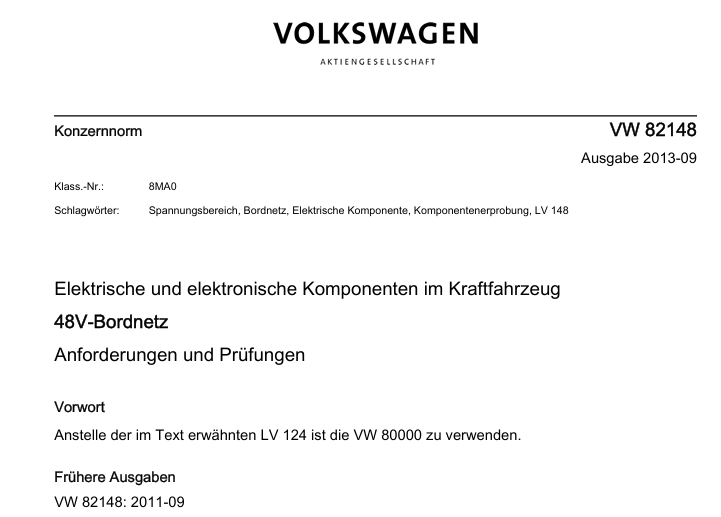
The reference norms include VDA 320 and VW 82148, which are the OEM-specific implementations of LV 148.
Side-by-side comparison
| ISO 16750 | LV 124 | LV 148 | |
|---|---|---|---|
| Origin | ISO (international) | German OEMs | German OEMs |
| Voltage domain | 12V, 24V (generic) | 12V, 16V, 24V | 48V |
| What it is | A single international standard | An umbrella term for OEM-specific norms | An umbrella term for 48V OEM norms |
| Automated test execution | Supported by RTStand | Supported by RTStand | Supported by RTStand |
| OEM derivatives | Used as baseline by many OEMs | VW 80000 (VW80000), BMW GS95024
(BMWGS95024), MBN 10567, etc. |
VDA 320, VW 82148 |
| Geographic prevalence | Global | Global — originated in Germany,
adopted worldwide |
Global — originated in Germany,
adopted worldwide |
Where they overlap — and where they do not
All three norms — ISO 16750, LV 124, and LV 148 — cover the same test domains: electrical, mechanical, climatic, and chemical. They all include short interruption tests (E13 group), voltage transients, overvoltage, and the full range of automotive environmental validation. The test types are largely the same across all of them.
The difference is not what they test, but how specifically they define it.
ISO 16750 defines test types with curves and values — but at a general, middle-ground level. A voltage ramp test in ISO 16750 has a defined ramp rate, start voltage, and hold time — they are not blank. But they represent an average across many vehicle types.
The OEM norms take these as a starting point and make them more precise. Sometimes the OEM norm is a tighter variation of the same ISO test case — a steeper ramp, a longer hold time, a lower minimum voltage. Sometimes it is an entirely different profile that reflects what matters for that OEM’s specific vehicle architecture. The OEM norms do not fill in blanks — they sharpen what ISO already defines, and add what ISO does not cover.
How OEM norms evolve
The typical progression: an OEM that does not yet have its own standard starts with ISO 16750 as the baseline. Over time, as they gain experience with their specific vehicle architectures, they develop more detailed and product-specific requirements. Eventually, these become a standalone company standard — like VW 80000 (VW80000), BMW GS95024 (BMWGS95024), or Tesla’s own specification. Some OEMs skip this progression entirely and adopt an existing OEM standard (often VW’s) with modifications.
The practical consequence: if you test according to a specific OEM norm (like VW 80000), you have typically also covered the corresponding ISO 16750 test types — because the OEM norm is a more precise version of the same test. The reverse is not necessarily true — passing ISO 16750 at its general values does not guarantee you pass the OEM’s specific parameters, which may be tighter, differently timed, or structured as a variation that ISO does not anticipate.
RTStand LV124 / LV148 — focused on electrical testing
All of these norms cover electrical, mechanical, climatic, and chemical testing. RTStand focuses exclusively on the electrical portion — voltage supply tests, short interruptions, short circuits, backfeeds, current monitoring, and communication line testing. The mechanical, climatic, and chemical tests are performed on separate equipment (vibration tables, climate chambers, chemical exposure rigs).
OEM norm variants
Both ISO 16750 and LV 124 / LV 148 serve as base standards. Individual OEMs then create their own variants — sometimes called company standards, norm derivatives, or OEM-specific test specifications. These add, modify, or tighten requirements based on the OEM’s specific vehicle architectures and quality expectations.
LV124 * LV148 * VW 80000 (2013–2022) * VW 82148 * BMW GS95024-2-1 (2010–2026) * BMW NCAR 2023 * BMW BTTests 2023 * Audi LAH 4N0419091 (2021) * Audi LAH 895941 (2023) * Audi LAH 89A947B (2024) * MBN 10567 (2018, 2024) * MBN LV124 (2013) * ISO 16750-12V (2012, 2023) * ISO 16750-24V (2012, 2023) * ISO 21780 (2020) * GMW 3172 (2018) * MAN 12V 3499 (2017–2020) * MAN 24V 3499 (2017–2020) * Scania TB5134 (2023) * Hyundai HKMC ES95400 * FCACS00054 (2018) * PSA B217110 (2019) * QJGAC 152028 (2022) * ChangAn VS0034L10002 * Renault RNDSC00517 * Lucid EEDRCS (2023) * Zoox ESPS (2024) * McLaren MSL03040004 * Volvo LAH33721792 * JLR EMCCS (2013) * KTM T201T202 (2023) * QLiA 3800001 etc.
A detailed guide to each OEM’s specific requirements and how they differ from the base standards.
How RTStand handles this
RTStand was designed from the ground up to handle the full complexity of LV 124, LV 148, ISO 16750, and all OEM variants. Every norm variant is implemented as a ready-to-use test profile in the norm library. The engineer selects the norm, the variant, and the test — RTStand executes it fully automated, including waveform generation, interruption switching, communication monitoring, and report generation.
The norm library currently includes 47+ norms and specifications, with continuous updates as OEMs release new versions. The upcoming 2026 SP1 release expands this to 50+ norms.
Need to test against LV 124, LV 148, and ISO 16750?
Talk to a WKS engineer. We will map your norm requirements to the right RTStand configuration — no commitment needed.
RTStand LV124 / LV148
Built by WKS Informatik GmbH · Ravensburg, Germany – Imprint