
In this article
ECU types & current profiles
Power outputs in modern ECUs — HSDs, half bridges, E-fuses, and terminal outputs.
ECUs are not just signal processors — they are power sources.
A common misconception in LV124 / LV148 testing is that ECUs only consume power. In reality, modern ECUs actively supply power to external sensors, actuators, and even other ECUs. A body control module powers its connected sensors via high-side drivers. A zone controller distributes power to downstream ECUs through E-fuses. A motor ECU drives external loads through half bridges.
This means your test setup must handle not just the ECU’s power input — but also its power outputs. During LV124 / LV148 testing, these outputs need to be monitored, interrupted, short-circuited, and stressed with overcurrents — exactly as they would be in a real vehicle under fault conditions.
Why this matters
If your test setup only tests the ECU’s supply input and ignores its power outputs, you are missing critical failure modes. An ECU that passes supply line tests but fails when one of its output pins is short-circuited has not been properly validated.
The four main power output types
Across 12V, 24V, and 48V networks, ECU power outputs fall into four main categories. Each has different characteristics, different protection mechanisms, and different implications for LV124 / LV148 testing.
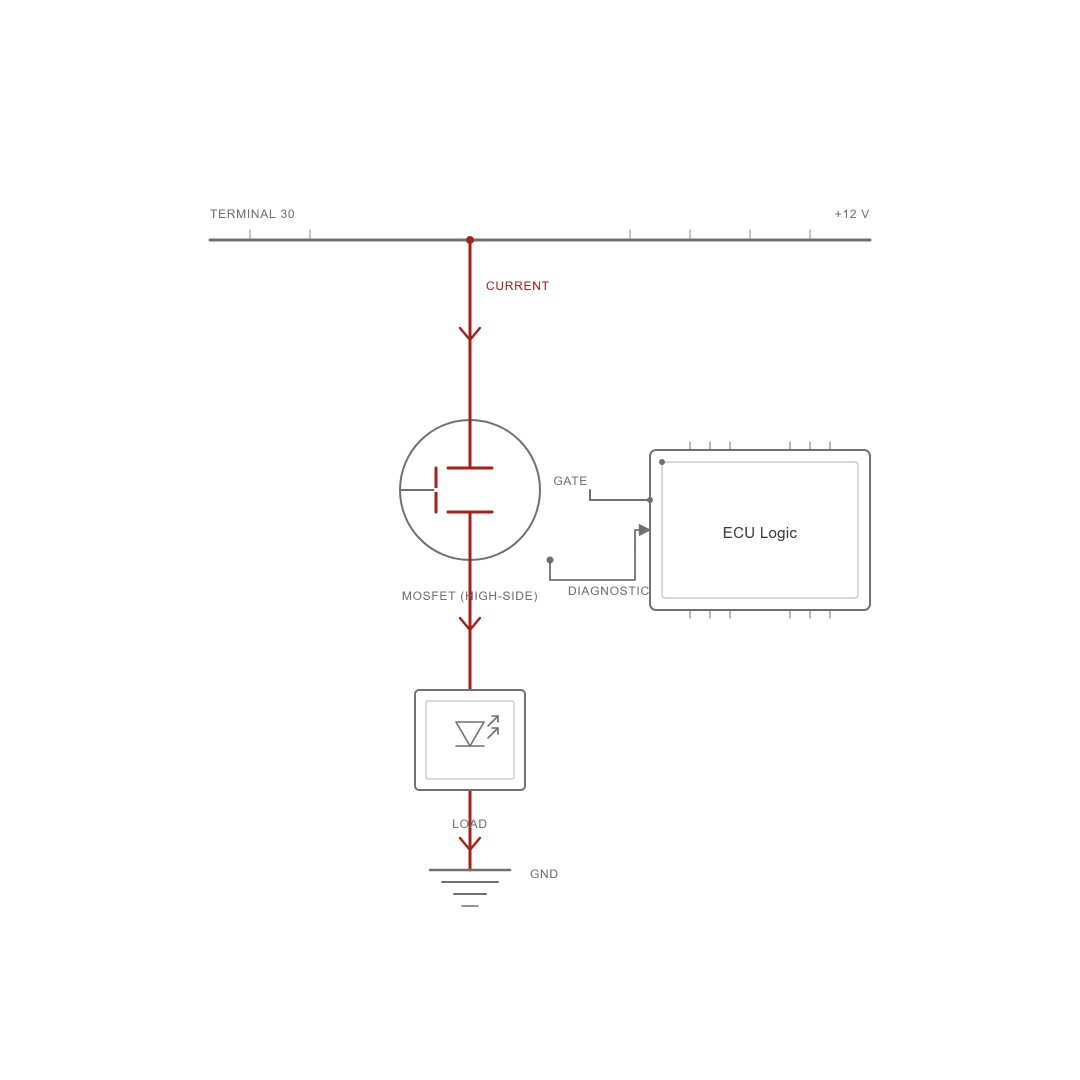
High-side driver (HSD)
Switches power from supply to load
The most common power output type. An HSD connects the supply rail (typically terminal 30) to an external load — a sensor, an LED, a relay. The ECU controls whether power is delivered, and monitors the output for faults.
- Typical current 0.5A – 5A per channel
- Protection Overcurrent, short-circuit, thermal shutdown
- Common in Body controllers, lighting ECUs, comfort modules
- LV124 relevance Short-circuit and overcurrent tests on each output pin
Half bridge
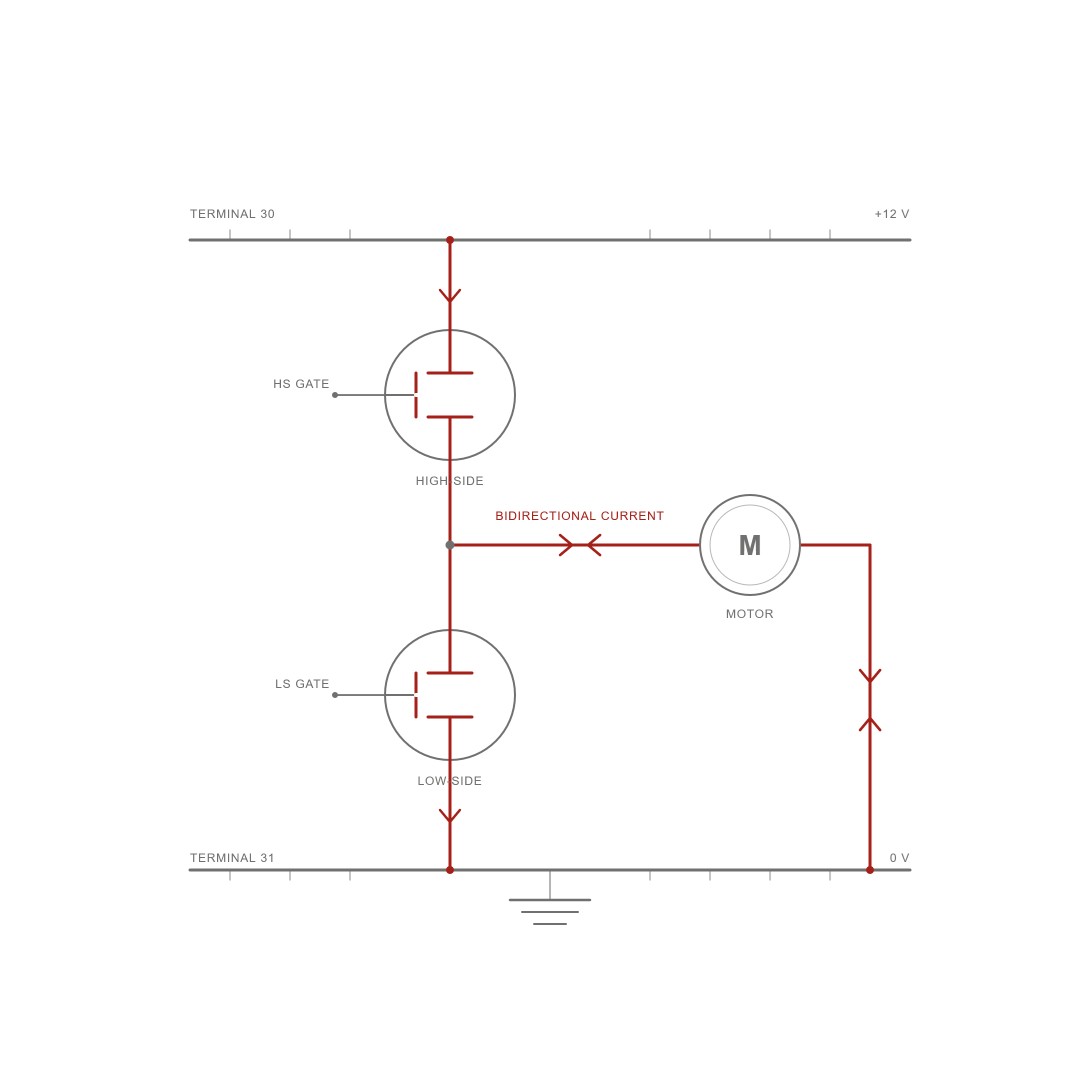
Bidirectional switching for motor control
A half bridge can switch a load between supply and ground — enabling bidirectional control of DC motors (e.g. window lifters, mirror adjustment, seat motors). More complex than an HSD, and the failure modes are different.
- Typical current 5A – 30A per channel
- Protection Cross-conduction protection, thermal shutdown
- Common in Motor ECUs, window controllers, seat adjustment
- LV124 relevance Short-circuit to supply and ground, backfeed tests
Smart fuse (E-fuse)
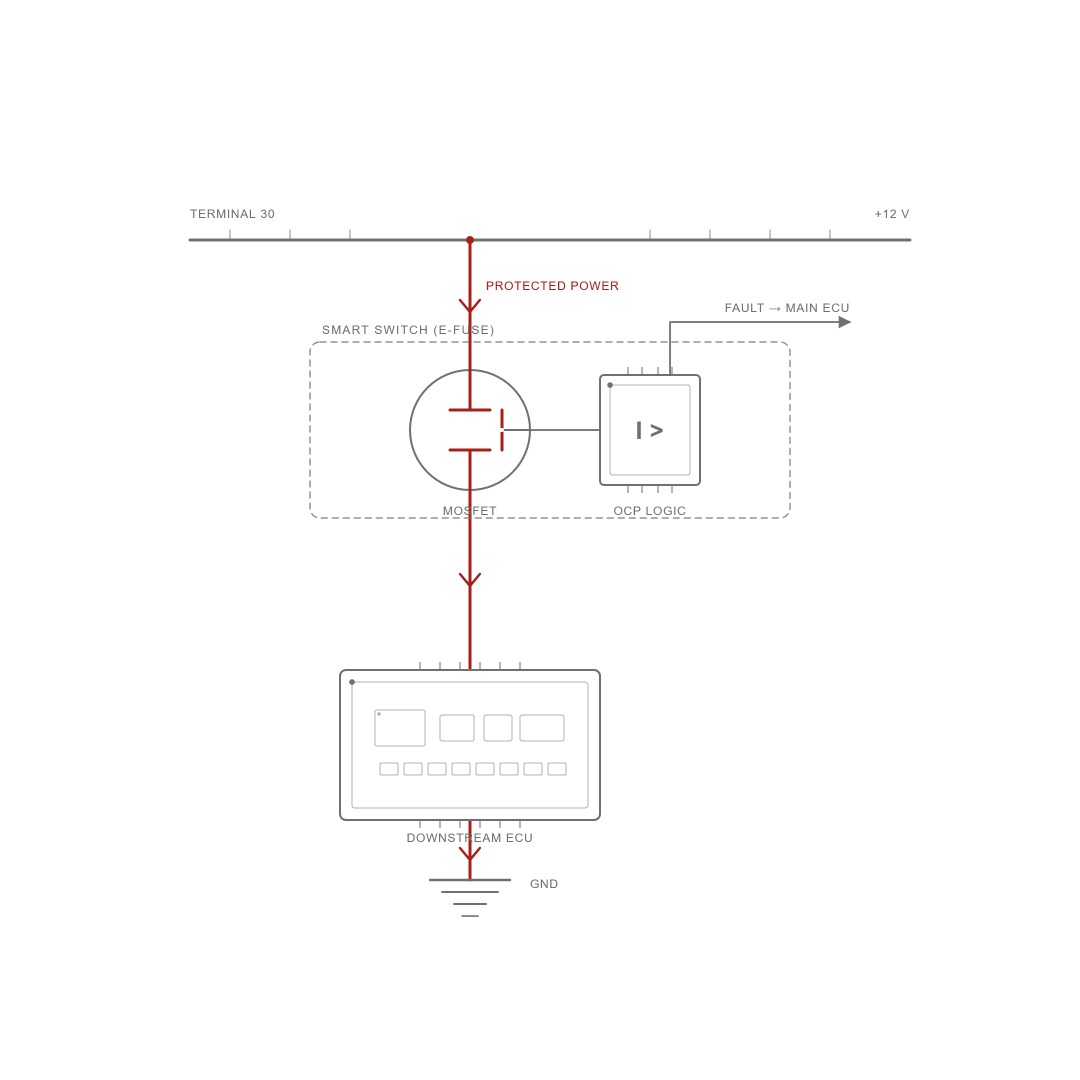
Electronic replacement for traditional fuses
E-fuses are increasingly used in zone-architecture vehicles to replace traditional blade fuses. They distribute power to downstream ECUs with programmable overcurrent thresholds, faster response than mechanical fuses, and the ability to reset automatically.
- Typical current 5A – 40A per channel
- Protection Programmable OCP, auto-retry, diagnostic reporting
- Common in Zone controllers, power distribution units, body domain
- LV124 relevance Overcurrent response characterisation, trip-time measurement
Terminal 30/31 outputs
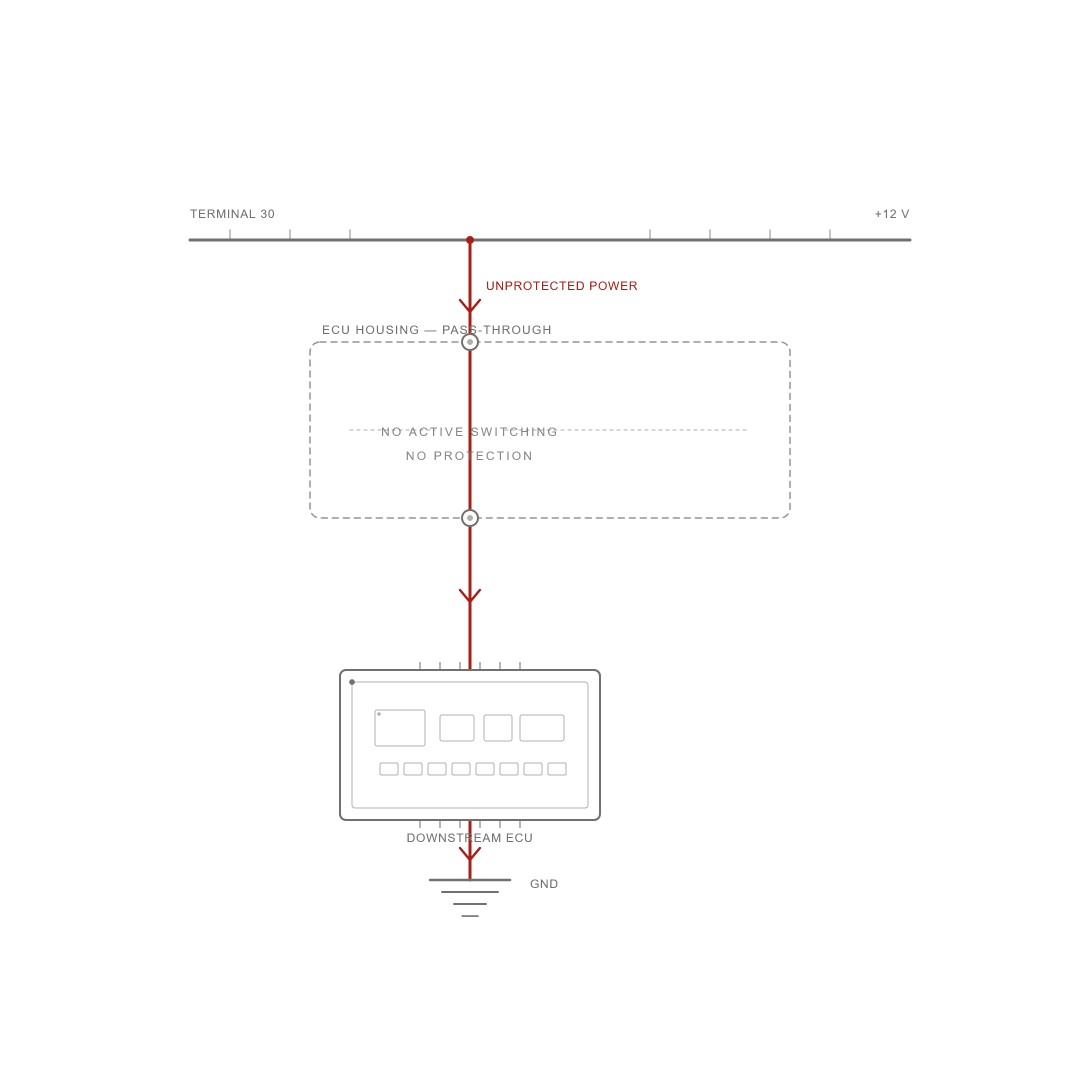
Direct power pass-through to other ECUs
Some ECUs pass through the vehicle supply (terminal 30) or ground (terminal 31) to downstream components — effectively acting as a power distribution node. These outputs carry whatever current the downstream load requires, often without active protection.
- Typical current Varies widely — 1A to 80A+
- Protection Often minimal — relies on external fusing
- Common in ECUs with daisy-chained power, harness junction boxes
- LV124 relevance Backfeed tests, overcurrent tests, interruption tests
How standardised are power output types?
The short answer: not very. Unlike communication interfaces (CAN is CAN, regardless of OEM), power output topologies vary significantly between ECU manufacturers. An HSD from one semiconductor vendor may have different protection thresholds, different diagnostic capabilities, and different failure modes than an HSD from another vendor — even though they serve the same functional purpose.
This creates a practical challenge for testing. You cannot assume that testing one HSD-based ECU tells you anything about how another HSD-based ECU will behave under the same conditions. Each ECU’s power outputs must be characterised and tested individually.
What OEMs specify
The OEM norm variants (VW 80000, BMW GS95024 etc.) define the test conditions — how much current to force, how long the short-circuit should last, what the acceptance criteria are. They do not specify how the ECU’s internal protection should work. That is the responsibility of the ECU designer.
The LV124 / LV148 tests that target power outputs
Some categories of LV124 / LV148 tests specifically target ECU power outputs. All must be performed per pin — meaning an ECU with 24 output pins requires 24 individual test runs for each test type.
Short-circuit tests
Each output pin is short-circuited to supply (terminal 30) and to ground (terminal 31) individually. The test verifies that the ECU’s protection activates correctly, that no permanent damage occurs, and that the ECU recovers to normal operation after the fault is removed.
VW 80000: E13 (short-circuit to ground), E17 (short-circuit to supply)
Overcurrent tests
A load is applied to each output pin that draws more current than the pin is designed for. This tests the overcurrent protection — E-fuses should trip at their programmed threshold, HSDs should enter thermal shutdown, half bridges should limit current. The test measures the response time and the recovery behaviour.
VW 80000: E22 (overcurrent on outputs)
All these test types must be performed while simultaneously monitoring the ECU’s supply voltage, current consumption, and communication bus behaviour. The ECU’s response on CAN/LIN — including any diagnostic trouble codes (DTCs) it reports — is part of the acceptance criteria.
How RTStand handles power output testing
RTStand was designed from the beginning to handle pinwise tests on every connection — not just the supply line. This includes all short-circuit, overcurrent, and backfeed tests on every output pin, fully automated and with parallel monitoring of all channels.
| Capability | How RTStand handles it |
|---|---|
| Short-circuit per pin | Automated switching connects each output pin individually to supply or ground. RTStand executes the test at the exact timing specified by the norm. All other pins continue to be monitored during the test. |
| Overcurrent per pin | Programmable load profiles per pin. The test system applies the specified overcurrent and measures the ECU’s response time, trip current, and recovery behaviour — all logged at 100kHz by the Tube Analyzer. |
| Reverse current per pin | External current is forced into individual output pins while monitoring the ECU’s supply current, output behaviour, and bus communication. The test verifies both protection and diagnostic reporting. |
| Parallel monitoring | All voltage channels, current channels, and communication lines are monitored simultaneously — time-synchronised. This is essential because a short-circuit on one output pin may affect the behaviour of other pins or the bus communication. |
| Automated sequencing | All pinwise tests are sequenced automatically. An ECU with 24 output pins runs all short-circuit, overcurrent, and backfeed tests across all 24 pins without manual reconfiguration between tests. |
Testing ECU power outputs on your DUT?
Tell us about your ECU’s output topology — HSDs, half bridges, E-fuses, or terminal outputs — and we will show you exactly how RTStand handles the pinwise tests for your configuration.
RTStand LV124 / LV148
Built by WKS Informatik GmbH · Ravensburg, Germany – Imprint