
In this article
ECU types & current profiles
ECU current profiles — categories, ranges, and what they mean for testing.
Modern automotive ECUs vary enormously in their current consumption — from sensor modules drawing under 1A to starter motor controllers pulling over 100A. Understanding where your ECU falls on this spectrum is not just a design question — it directly determines which test equipment you need, which RTStand variant is appropriate, and how long your LV124 / LV148 validation will take.
This article categorises ECUs by their current consumption, gives real-world examples in each category, and maps each to the appropriate RTStand system variant.
Why current profiles matter for LV124 / LV148 testing
LV124 and LV148 require testing across the full operating range of an ECU’s power supply. The electrical disturbance profiles — voltage transients, interruptions, short circuits — must be generated at the correct current level for the DUT. An amplifier rated for 30A cannot test a motor controller that draws 60A under load.
This means the choice of test system is not just about pin count or norm coverage — it is fundamentally about current capability. Choosing a system that is under-specified for your ECU’s current requirements will either produce invalid results or damage the equipment.
Practical implication
Before configuring any LV124 / LV148 test run, the first question is: what is the maximum current consumption of the DUT, including inrush? This determines the amplifier, the cabling, and the system variant.
The three ECU current categories
Based on our experience across hundreds of ECU validation projects, automotive ECUs cluster into three natural current categories. These are not formal norm categories — they are practical groupings that map directly to test equipment requirements.
Category 1
< 25A
Low-current ECUs
- Sensors and sensor modules
- Body control units
- Comfort modules
- Rain / light sensors
- Instrument clusters
- Most lighting ECUs
- Communication gateways
Category 2
< 80A
Medium-current ECUs
- Electric pumps (water, oil, fuel)
- Cooling fans
- Electric power steering (EPS)
- Seat adjustment motors
- HVAC blower motors
- Wiper systems
- Advanced lighting (matrix LED)
Category 3
> 80A
High-current ECUs
- Starter motors / controllers
- Mild hybrid BSG / ISG
- DC/DC converters
- Battery management systems
- Electric turbocharger ECUs
- Active roll stabilisation
- High-power 48V consumers
Category 1: under 25A — sensors and control units
This is the most common category by unit count. The majority of ECUs in a modern vehicle fall here — they process signals, manage communication, and control low-power actuators. Their current consumption is modest, typically in the range of 0.5A to 15A steady-state, with inrush peaks rarely exceeding 20A.
From a testing perspective, Category 1 ECUs are the most straightforward. They require precise voltage generation and monitoring — the test waveforms must be accurate — but the power requirements are manageable with standard amplifiers. The challenge with Category 1 ECUs is usually pin count and communication complexity rather than current.
A typical Category 1 ECU might have 8 to 24 power pins plus CAN, LIN, and increasingly Automotive Ethernet interfaces — all of which need to be monitored during the full LV124 / LV148 test run.
Testing insight
For Category 1 ECUs, the bottleneck is not current — it is the number of communication interfaces and the requirement to monitor them all simultaneously during electrical stress tests. This is where many manual setups fail, even though the power requirements are simple.
Category 2: under 80A — pumps, fans, and steering
Category 2 includes ECUs that drive significant mechanical loads — electric motors, pumps, heating elements. Their steady-state consumption typically ranges from 15A to 50A, but inrush current at startup or under load changes can spike to 60–80A.
These ECUs present a specific challenge for LV124 / LV148 testing: the test system’s amplifier must handle the peak current without clipping or distorting the voltage waveform. A 30A amplifier that clips during a 60A inrush peak will produce invalid test results — the voltage profile at the DUT will not match what the norm specifies.
Category 2 ECUs also tend to have fewer communication interfaces but more complex power output behaviour — some actively supply power to external sensors or actuators (via HSDs, half bridges, or E-fuses), which means the test system must also handle backfeed and overcurrent tests on those output pins.
Category 3: over 80A — starters and hybrid drives
Category 3 is the most demanding from a test infrastructure perspective. These ECUs draw 80A or more in normal operation, with peak currents that can exceed 150A during startup transients. Starter motors, mild hybrid belt-starter-generators (BSG/ISG), and DC/DC converters all fall here.
Testing Category 3 ECUs under LV124 / LV148 requires high-power amplifiers, heavy-gauge cabling, and thermal management for extended test runs. The test system must generate the full range of LV124 voltage disturbance profiles at these current levels — which is technically challenging and physically demanding on the equipment.
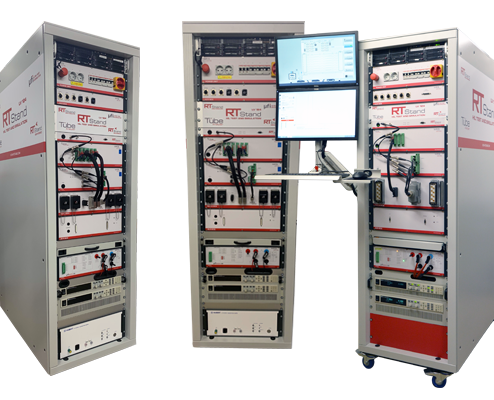
This is exactly why WKS developed the RTStand F8-90 variant — the newest addition to the RTStand family, specifically designed for ECUs with current consumption up to 90A. It uses the same software framework and automation capabilities as the 30A variants, but with a power stage designed for high-current applications.
Mapping ECU categories to RTStand variants
RTStand offers five system variants — each designed for a different combination of pin count and current capability. The right variant depends on both dimensions: how many pins your ECU has, and how much current it draws.
Category 1 — under 25A
F8-30 / F24-30 / F48-30 / F96-30
Any 30A variant works. Choose based on pin count: F8 for simple ECUs, F24 and F48 for mid-range, F96 for complex ECUs with many connections. All include 14+ bus pins and 8+ Ethernet/GMSL pins.
Category 2 — under 80A
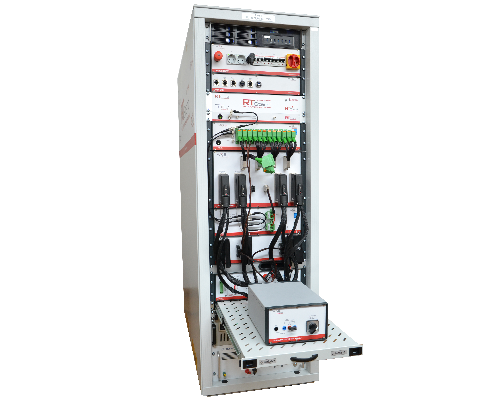
F8-30 + amplifier add-on, or F8-90
For ECUs in the 30–80A range, either use a standard variant with the optional >2kW amplifier add-on, or step up to the F8-90 for native high-current support. Discuss with WKS to determine the best fit.
Category 3 — over 80A
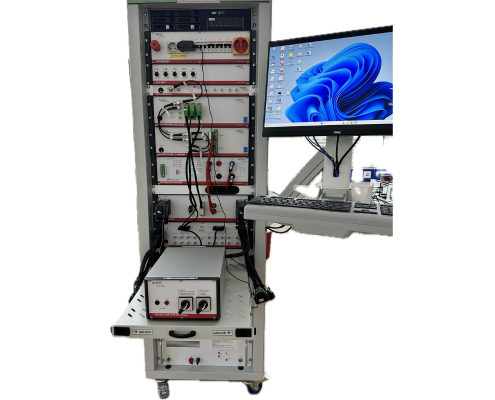
F8-90
The F8-90 was designed specifically for this category — supporting up to 90A current consumption with the same full automation, monitoring, and reporting as all other variants.
| Variant | Power pins | Max current | Bus pins | Ethernet/GMSL |
|---|---|---|---|---|
| F8-30 | 8 | 30A | 14+ | 8+ |
| F24-30 | 24 | 30A | 14+ | 8+ |
| F48-30 | 48 | 30A | 14+ | 8+ |
| F96-30 | 96 | 30A | 14+ | 8+ |
| F8-90 | 8 | 90A | 14+ | 8+ |
Inrush current vs steady-state — a critical distinction
When specifying your test system, always consider peak inrush current — not just steady-state consumption. Many ECUs draw significantly more current during startup or load changes than during normal operation. A motor controller might draw 12A steady-state but spike to 45A during startup.
The test system’s amplifier must handle the peak without distortion. If the amplifier clips during inrush, the voltage profile at the DUT will be wrong — and the test results will be invalid.
Practical recommendation
If you are unsure about your ECU’s peak current, measure it before configuring your test system. RTStand’s Tube Analyzer can log current at 100kHz resolution — often used as a preliminary step to characterise the DUT before the full LV124 / LV148 test run begins.
What changes at 48V?
48V systems (tested under LV148 rather than LV124) tend to cluster in Category 2 and Category 3. The higher voltage means that even moderate power consumers draw substantial current — and the transient profiles are different from 12V systems.
RTStand supports 12V, 24V, and 48V power networks across all variants. The F8-90 is particularly relevant for 48V applications because many 48V ECUs — electric turbochargers, active suspension, mild hybrid drives — are high-current consumers by nature.
For a detailed comparison of LV124 and LV148 — including the specific differences in voltage ranges and test parameters — see the pillar article: What is LV124 / LV148? The complete guide.
Not sure which variant fits your ECU?
Tell us about your ECU’s current profile and pin count. We will recommend the right RTStand variant — or explain when the amplifier add-on makes more sense than stepping up to the F8-90.
RTStand LV124 / LV148
Built by WKS Informatik GmbH · Ravensburg, Germany – Imprint